Environmental Compliance & Firefighting Systems — cut CO₂ and foam footprint without slowing operations
Environmental compliance firefighting systems isn’t a slogan. It’s the way safety work is planned, executed, and evidenced so class, flag, and ports accept it on the first look.
Why environmental compliance firefighting systems matter now
Safety still comes first. The next question is how we test, document, and reduce the footprint. CO₂ venting during service, old fluorinated foams, and “paper-only” records add up across a fleet. Ports from Klaipėda and Riga to Gdynia, Tallinn, Helsinki, Rostock, and Rotterdam increasingly expect proof that the job was done cleanly as well as correctly.
The hidden impact of shipboard FFE
A few cylinders and a foam tank don’t look like much. Scale it to thousands of vessels and the totals are not small: avoidable gas releases, contaminated concentrates, and waste from repeat work. That is why MSC.1/Circ.1318 and MSC.1/Circ.1432 lean on one principle: test and maintain, but minimise emissions and residues while you do it.
CO₂ systems: zero-release as a default
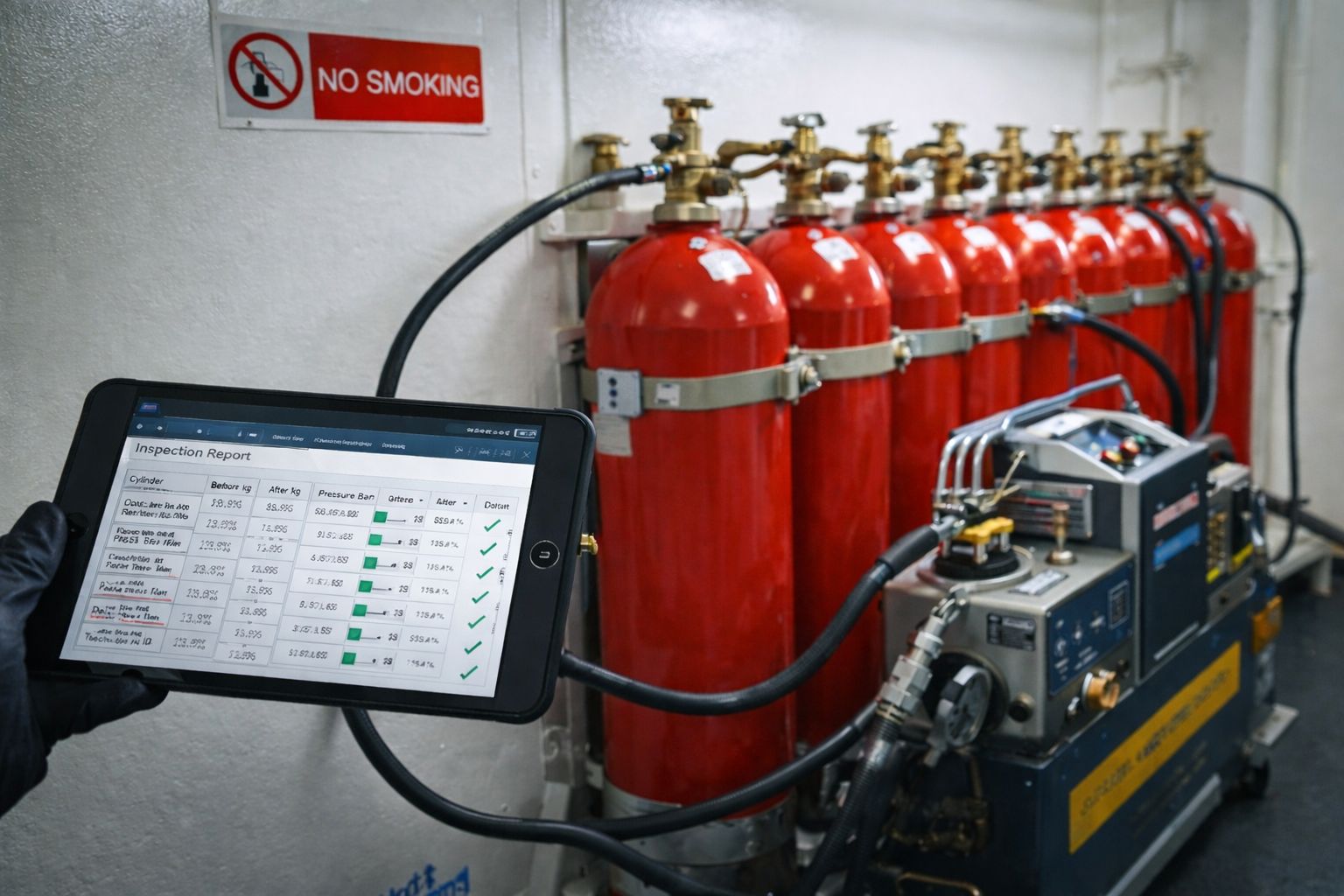
On fixed CO₂, our baseline is simple: no venting unless there is a genuine test requirement. We use recovery and transfer units to capture and return gas, then log every step under ISO 9001 traceability: cylinder ID, tare/gross, pressure, and technician ID. This cuts emissions and protects your inventory. It is environmental compliance firefighting systems in practice: recover, record, and avoid routine discharge.
Foam systems: switch to fluorine-free, dispose the old correctly
AFFF and other legacy concentrates carry long tails in water and soil. During service we sample, test (pH, expansion, drainage), and remove expired or contaminated stock through certified waste partners. Where the fire plan allows, we recommend modern fluorine-free foams that meet IMO guidance and EU Green Port expectations. Upgrading foam is now core to environmental compliance firefighting systems across Baltic and North Sea ports.
Efficiency is sustainability in disguise
Leaks repaired, seals replaced, proportioners calibrated, strainers cleaned — small tasks that prevent repeat visits, spare part churn, and transport miles. Routine care under SOLAS II-2/14 and class procedures lowers cost and footprint at the same time.
Regional model that cuts logistics emissions
Our mobile teams work pier-side in Klaipėda, Riga, Gdynia, Tallinn and onward to Świnoujście, Aarhus, Gothenburg, and Hamburg. We bring the workshop to the ship: hydrotest units, foam kits, weighing gear, documentation tablets. Fewer road transfers for heavy cylinders, less idle time, faster certificates.
Digital traceability auditors actually like
Paper gets lost. Digital doesn’t. Each job generates a time-stamped record with photo IDs, serials, calibration references, and sign-off. Class and flag can verify it in minutes, and PSC reviews are quicker when the file is on a tablet instead of somewhere in the mess room.
ESG reporting: turn service data into trust
Charterers and terminals want evidence, not stories. Our reports map directly to ESG claims: CO₂ recovered vs discharged, foam volumes replaced, waste streams handled, and travel saved by regional deployment. The same package that satisfies class also supports sustainability disclosures.
Safety and sustainability: two sides of the same mission
A system that saves the crew should not harm the port. That is the standard. With recovery on gas systems, cleaner foam choices, regional attendance, and digital records, you get safety, compliance, and a smaller footprint — together, not in trade-off.
OJ Safety — ISO 9001:2015 Certified | RINA Approved | MSC.1/Circ.1318 & MSC.1/Circ.1432 compliant
FFE inspections, CO₂ recovery, foam servicing and class-accepted reports across Lithuania, Latvia, Estonia, Poland and Finland, with established routes into Denmark, Sweden, Norway, Germany and the Netherlands.