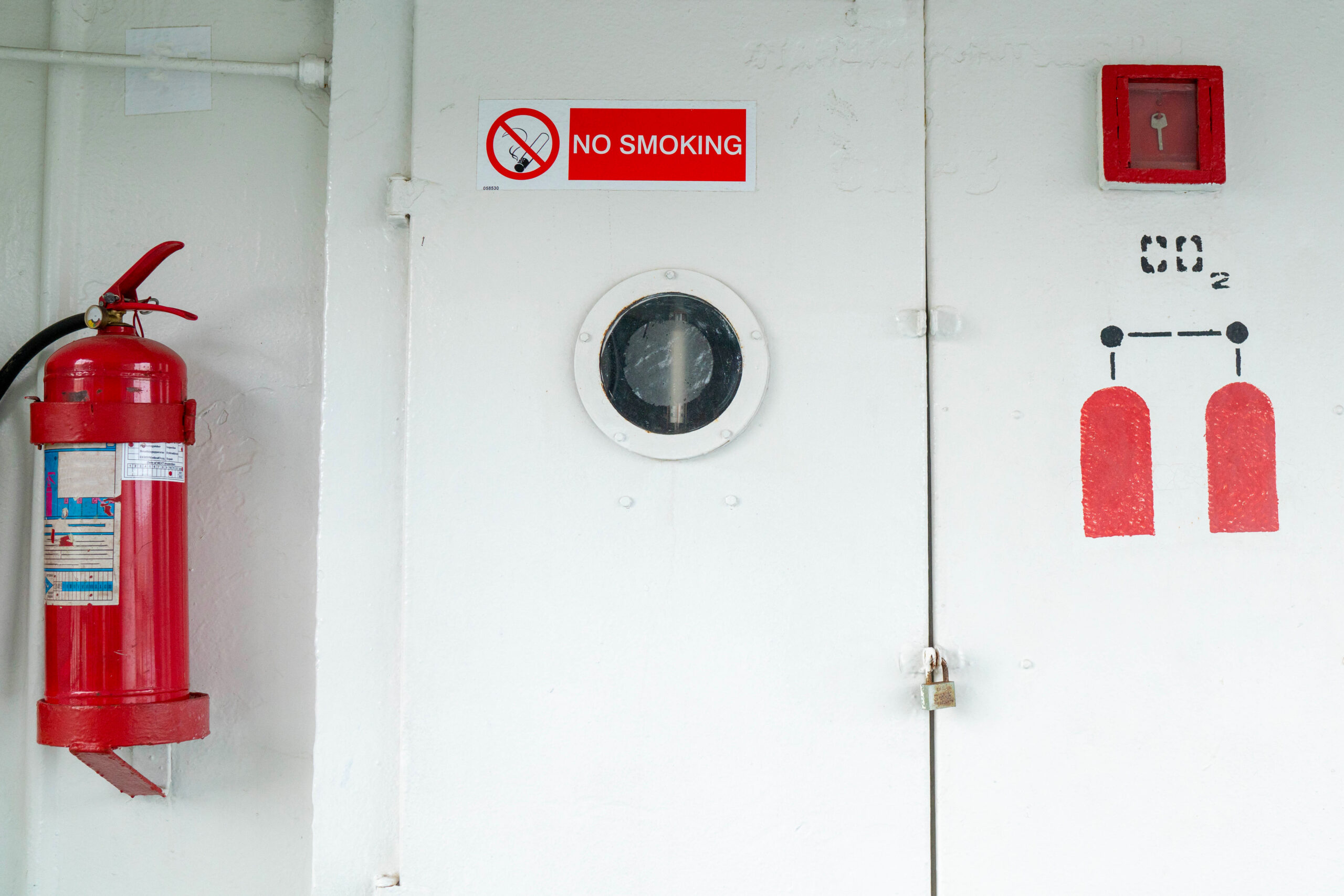
From January 2026, the Lithuanian Flag tightens how firefighting equipment is inspected and certified. The goal is simple: cleaner documentation, verified competence, and smarter environmental practice. If your vessels trade the Baltic and North Sea corridor, this will make port calls faster when you’re organized, and slower if you’re not.
What changes (in plain words)
Lithuania is aligning national practice with IMO and SOLAS so that reports issued in Klaipėda read the same way in Riga, Gdynia, Tallinn, Helsinki and beyond. Annuals and five-yearlies for portable extinguishers, fixed CO₂, foam, and detection will be valid only when done by authorized service stations working under ISO 9001 and recognized by class.
The rulebook it follows
Expect the procedures to reference the usual anchors:
-
IMO MSC.1/Circ.1432 — maintenance and inspection of fire protection systems
-
IMO MSC.1/Circ.1318 — CO₂ system maintenance and hydro testing
-
SOLAS II-2/14 — periodical testing of fixed and portable systems
Translation: if your provider can’t map every task to these, you’ll argue with surveyors.
Who is allowed to service your FFE
Approved companies must show:
-
ISO 9001 certificate in force
-
Class recognition (RINA, DNV, BV, ABS or LR)
-
Technician competence logs and brand-specific authorizations
-
Calibrated instruments with valid certs
-
Traceable documentation that matches flag/class templates
This makes reports portable across Baltic and EU ports and reduces PSC friction.
These provider criteria are explicit in **Lithuanian Flag 2026** guidance.
Lithuanian Flag 2026: digital recordkeeping becomes mandatory
Lithuanian Flag 2026: data you must store
Paper isn’t dead, but the source of truth is digital. Every FFE job must store, at minimum:
-
Cylinder serials and valve/pressure readings
-
Foam sample results (pH, expansion, drainage)
-
Technician ID and authorization reference
-
Instrument calibration IDs and due dates
Records must be archived ≥5 years and shown on request to flag, class, or auditors. Tablets with QR-coded reports will end “we’ll email it later.”
Onboard documentation: ready for audit in seconds
Ships under the Lithuanian flag should keep FFE service certs onboard and cross-referenced to Form E. That link between physical kit and statutory paperwork is what PSC checks first. Digital copies close gaps between ship and shore records and cut inspection time.
Environmental responsibility enters the workflow
FFE servicing now logs your footprint:
-
CO₂ recovery where practicable, with notes on mass handled
-
Foam collection and proper disposal/recycling tickets
-
Less waste through digital reporting instead of stacks of paper
This lines up with EU green port expectations and will show up in renewals.
What this means for shipowners and managers
Early adopters get faster clearances, cleaner audits, and fewer questions. The market narrows to providers that are approved, digital, and audited. For Baltic/Nordic loops, a regional partner that can cover Lithuania, Latvia, Estonia, Poland, Finland (and set foundations for Denmark, Sweden, Norway, Germany, Netherlands) is the time saver.
How to be ready on day one
-
Pick an approved station with ISO 9001 and class recognition.
-
Ask for names: technician IDs, OEM brand authorizations, recent experience.
-
Demand digital packs: serials, measurements, photos, calibration refs, QR certs.
-
Sync documents onboard and cross-link to Form E.
-
Log environmental handling of CO₂ and foam in the report.
OJ Safety (Klaipėda) already operates this way: ISO 9001 in force, RINA approval, technician competence logged, digital archiving, class-accepted report formats. Jobs are issued in a format recognized by RINA, DNV, BV, ABS, LR and the Lithuanian Flag Administration.
Book in Klaipėda — FFE annuals and five-yearlies with digital, class-accepted evidence.
Coverage: Klaipėda, Riga, Tallinn, Gdańsk, Gdynia, Helsinki, Kotka, Turku, Stockholm, Gothenburg, Malmö, Copenhagen, Aarhus, Oslo, Bergen, Hamburg, Bremerhaven, Rotterdam, Amsterdam.