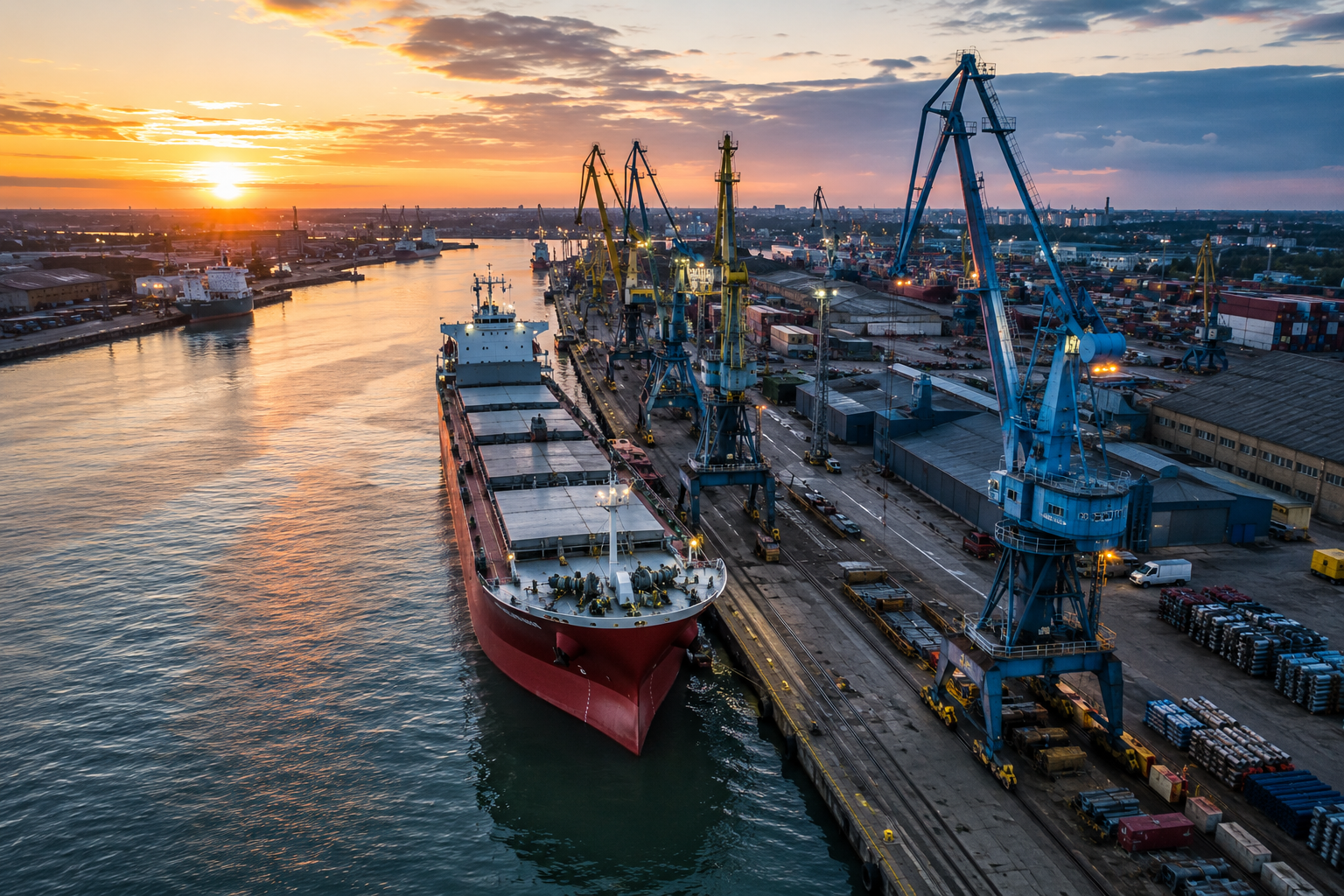
The cheapest port on paper is almost never the cheapest port in reality. A vessel that saves €4,000 on port dues but loses a day waiting for a service technician has lost the saving five times over. For annual LSA and FFE inspections — work that has to happen, has to be accepted by class, and usually has to fit inside a tight commercial schedule — the right port is the one where the work gets done cleanly, in the window the vessel already has, with documentation that doesn’t bounce back.
There is no single best answer. The right port depends on what the vessel is doing, when, how it’s chartered, and which flag and class are involved. But there are patterns worth knowing before the next annual gets scheduled — patterns that look quite different across the three regions we work in every week: the Baltic, the Nordics, and the North Sea / Continental hubs.
What “cost” really means for an annual
Port dues are the obvious line item, but they’re rarely the largest. The full cost of an annual port call usually breaks down into four buckets:
- Port costs: dues, pilotage, towage, agent fees. Visible on the agent’s pro-forma and easy to compare.
- Service costs: supplier rate, technician travel, accommodation, mobilisation surcharges.
- Class costs: surveyor attendance and travel — and the time their availability dictates for the rest of the plan.
- Vessel cost: the big one. Every day alongside is daily charter rate, idle bunkers and lost cargo time.
The first three are negotiable and roughly predictable. The fourth — vessel idle cost — is what punishes a bad port choice. On a Supramax the day rate is typically in the order of €12-18k at the moment of writing; on a tanker or PCTC it can be three or four times that. Any saving on port dues has to be measured against the probability of one extra day in port. That changes the picture quickly.
Baltic — Klaipėda, Riga, Tallinn, Gdańsk / Gdynia
The Baltic is the most cost-efficient option for annuals when the vessel’s schedule allows. Port dues are lower across Klaipėda, Riga, Tallinn and the Polish twin ports than anywhere in Western Europe. Service supplier availability is solid in the major hubs and mobilisation is fast — for a Klaipėda-based team a typical service window opens inside 24-48 hours, weekends included. Klaipėda itself stays ice-free year round; the Gulf of Finland and the northern Gulf of Riga can see meaningful ice from January through March, and Helsinki access in deep winter is a real planning factor, not a paper one.
Daylight is the other Baltic factor most planners underestimate. From late November through January some external work — davit visual inspections, hull-side paintwork checks, anything that depends on natural light — is genuinely affected by the four to six hour daylight window. Class presence is good across the region: RINA, DNV, LR, BV and ABS surveyors all attend Klaipėda regularly, and the same is true of Riga, Tallinn, Gdańsk and Gdynia.
Where the Baltic gets less attractive: vessels on tight Atlantic or Mediterranean rotations adding a Baltic call only for the annual rarely save money once deviation, bunkers and time are factored in.
Nordics — Helsinki, Stockholm, Gothenburg, Copenhagen, Oslo
Service infrastructure in the Nordic ports is excellent. Spares are available, technicians are experienced, customs handling is efficient and class presence is dense. None of this is cheap. Labour costs, port dues and the cost of moving spares through Scandinavian customs all add up. Where the Nordics win is for vessels already calling there — particularly Nordic-flagged tonnage and operators with established agent relationships in Helsinki, Gothenburg or Oslo. The premium pays for itself when the alternative is a deviation.
Two practical points worth flagging. Helsinki and Stockholm have winter access constraints — ice class and icebreaker assist are real considerations between mid-January and March. And flight connections into the smaller Nordic ports are limited; technician travel usually routes through Helsinki, Copenhagen or Oslo as gateway airports, with the last-mile by car or domestic flight adding a half-day each way. That last-mile cost is invisible in the quote but very visible in the schedule.
North Sea & Continental — Hamburg, Bremerhaven, Rotterdam, Antwerp, Aberdeen
If the vessel is already trading the North Sea, this is the region with the deepest service ecosystem in Europe. Hamburg and Rotterdam between them offer almost any spare, almost any technical specialism and almost any class surveyor within a day’s notice. Flight connectivity into Hamburg, Schiphol, Brussels and Aberdeen is the strongest in Europe — technicians from any country are realistically two flights away.
The cost of all that is twofold. Port stay costs are the highest of the three regions, and demand on service suppliers means booking pressure is real, especially in the spring and autumn drydock peaks. A confident “we’ll arrange it on arrival” call to Rotterdam in March can turn into a 48-hour wait for the right specialist. Aberdeen has its own profile — built around the offshore industry, excellent for OSVs, AHTSs and supply vessels, less optimised for box-shape commercial tonnage.
How early to book — the lead time question
Lead time is the single most underestimated factor in annual port planning. Realistic guidance from what we see in the booking flow each month:
- 2-4 weeks: comfortable in any Baltic port; achievable for Nordics outside winter peak.
- 4-6 weeks: the safe default everywhere, and what most class societies prefer for surveyor scheduling.
- 6-10 weeks: needed for Hamburg, Rotterdam and Antwerp in the March-April and September-October peaks; needed for any drydock-adjacent work; needed if specialist spares (release gear, certified hoses, davit wires) must be sourced.
- 24-72 hours: possible, especially in the Baltic, but the cost differential is real — and surveyor availability, not the service supplier, usually becomes the binding constraint.
The lead time that actually matters is not when the work starts. It is when the technician, the spares and the class surveyor can all be on the gangway at the same time.
Where the savings really come from
Choosing the cheapest port is rarely the answer. Sequencing the work in a port the vessel is already calling almost always is. A few patterns that consistently work:
- Combine the LSA annual and the FFE annual into one attendance — one mobilisation cost instead of two.
- Bundle davit, lifeboat release gear and load testing when 110% SWL is due in the same year.
- Pre-check the documentation before the surveyor attends — most “extra day” findings are paperwork, not physical defects.
- Time the annual to a planned crew change port — the vessel is already alongside for a different reason.
How we work across the three regions
OJ Safety is based in Klaipėda and mobilises across the Baltic, the Nordics and the North Sea on a weekly basis. In practice that means we know what the booking pressure looks like in Hamburg next month, how long Finnish customs are taking on incoming spares this week, and which Polish port has surveyor availability the week the vessel will be there. None of this changes the regulations — but it changes how realistically a given port slot can be made to work for a specific vessel.
Faster in the Baltic, slower (and more expensive) the further west the vessel goes — but reachable, and worth doing when the schedule says so. The honest answer is almost always that it depends on the vessel.
If you are planning an annual in the next six months, send us the ports the vessel might be calling at. We will come back with a frank view on which one actually makes sense — with realistic lead times for each.
Contact OJ Safety · See our LSA & FFE Services