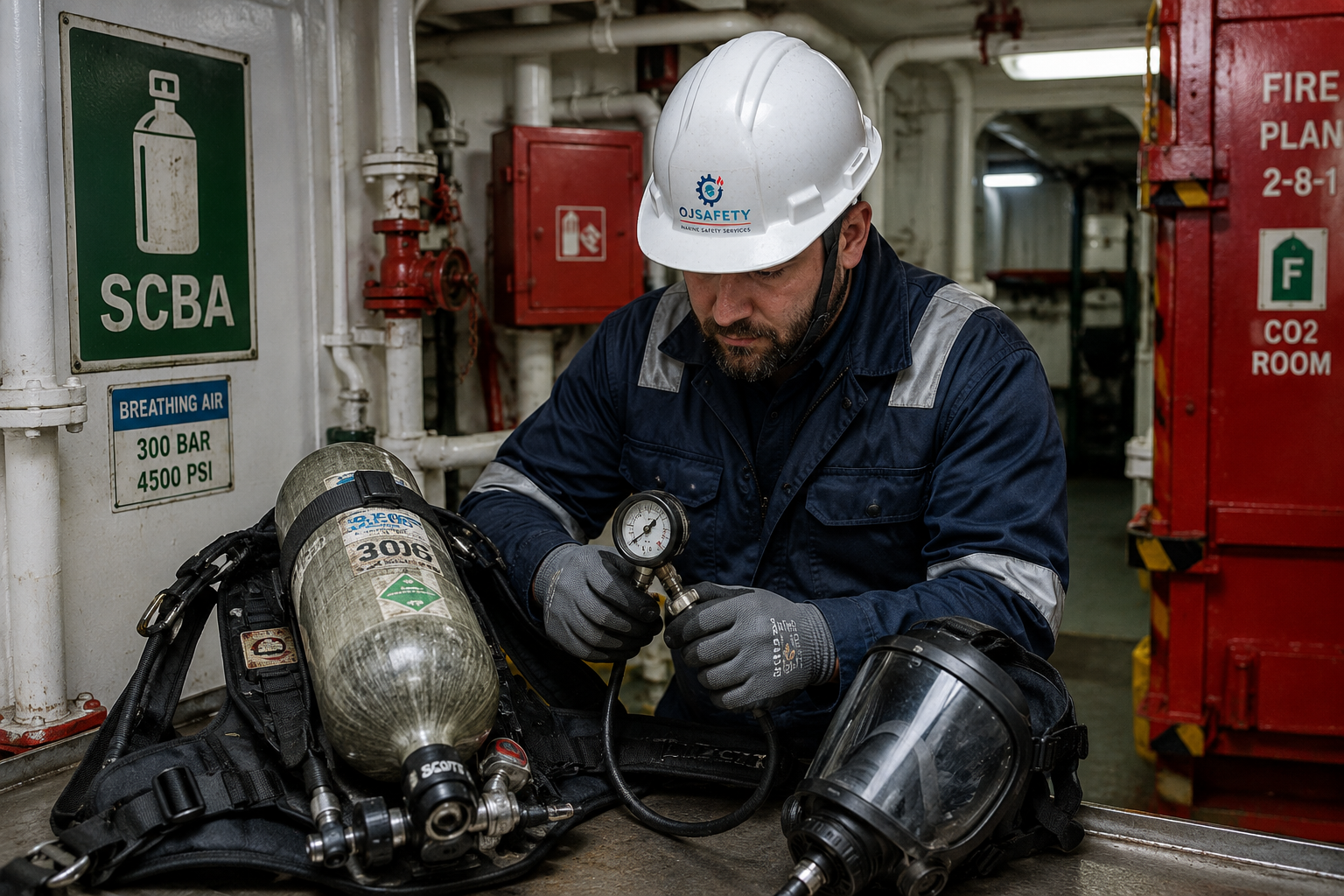
The inspector does not start with the logbook. He picks up the nearest SCBA set, checks the cylinder gauge, lifts the mask, and presses the seal against his face. That takes about forty seconds. And in those forty seconds, more vetting and PSC audits turn difficult than at almost any other point in the inspection.
We service and document SCBA and EEBD units across Baltic, Nordic and North Sea ports every week. The rejection reasons are nearly always the same. However, they are also nearly always fixable — if you know what the inspector is actually looking for. Here is what we find most often, in the order we see it.
1. The mask and face seal
This is the most common rejection we see. Seals do not fail dramatically. Instead, they dry out, harden slightly, and lose their ability to form a proper fit. The inspector will press the mask to his face, cover the inlet valve, and inhale. If the seal leaks, the set fails. That is the whole test, and it takes five seconds.
In practice, the following seal-related issues cause rejection most often:
- Cracked or hardened silicone or rubber seal — often from age or UV exposure in storage
- Permanent compression marks from long-term storage with straps overtightened
- No record of when the seal was last replaced or inspected
- Seal that looks intact visually but has never been fit-tested with a traceable result
The fix is straightforward. Seals need replacement on a schedule — typically annually, or as the manufacturer specifies. However, what matters for the inspection is not just the replacement itself. You need a record per unit, per seal change, with a date and technician reference. Not a fleet entry. Per unit, per date.
2. Cylinder pressure — and the date behind the reading
The gauge reads full. Unfortunately, that is not enough on its own.
Inspectors check several things around the cylinder. First, they confirm pressure is at the required level — typically 300 bar for a compressed-air SCBA. Then they look at when the cylinder was last hydrostatically tested. After that, they check whether the test date is stamped on the cylinder and whether it matches the service records. Finally, they want to see when pressure was last verified — not a note saying “satisfactory,” but an actual bar reading in the log.
Cylinders need hydrostatic testing on a fixed schedule. Usually that is every five years, but always confirm this with your flag state and class society. A cylinder past its hydrostatic test date is a straight rejection. There is no discussion.
Practical check: Look at the cylinder shoulder or collar. The hydrostatic test date is stamped there. If the date is approaching or already past — the set will fail, regardless of what the pressure gauge shows.
3. Dates — and there are more of them than most people expect
An SCBA set carries a surprisingly large number of date-sensitive items. Each one is a potential finding. As a result, audits often catch vessels that thought their sets were fine.
Here are the date-related rejections we see most frequently:
- Annual service overdue — the service date stamp on the unit or in records does not match the current year
- Seal or component replacement overdue — manufacturer’s service manual specifies intervals, and those intervals are tracked per unit
- Cylinder hydrostatic test overdue — the most common and most serious date finding
- Compressor filter last changed — date missing or overdue — compressor filters are often forgotten between SCBA services
- Air quality certificate expired — covered in more detail below
In practice, if there is no date written somewhere traceable, the inspector treats the action as never done. “We did it last year” does not work without paperwork. That sounds obvious, but it catches experienced crews regularly.
4. Records — the reason good-looking equipment still gets rejected
This is the rejection that surprises people most. The equipment looks fine. Pressure is correct. The mask appears intact. However, the records do not support what the inspector is holding.
Specifically, these are the record failures we encounter most often:
- No unit-level identification in records — entries say “SCBA checked” but do not reference a serial number, rack position or unit ID
- Units cannot be matched to their records — identification numbers are worn off the equipment, or records use a different reference system
- Entries contain no measured values — words like “inspected” or “OK” with no pressure reading, no seal condition note, no technician name
- Service was done by an unapproved provider — no class or flag state acceptance, just an invoice from a local company
- Unexplained gaps in the record — a period of months or years with no entry and no reason given
For class and vetting purposes, records must be traceable. The chain is: each unit → its own service history → measurable outcomes → approved provider. If any link in that chain is missing, the record fails — even if the equipment itself is in good condition.
5. Compressor and air quality
This is often the last item on the checklist. It is also the one that generates the most unexpected findings.
A breathing air compressor needs several things to be in order. First, it needs regular filter changes — carbon molecular sieve filters and particulate filters — with dates logged per change. Second, it needs air quality testing at defined intervals. Third, it needs a certificate from an accredited testing lab. That certificate must show CO, CO2, oil vapour, moisture content and particulate levels — all within the limits required by SOLAS and the FSS Code. Fourth, the certificate must reference the specific compressor and location on board.
What we typically find in practice: the compressor has been serviced, but the air quality certificate is expired. Alternatively, the certificate exists but refers to a different compressor or a shore-side filling station rather than the vessel’s own unit. Or the filter change log shows filters have not been changed within the manufacturer’s specified interval.
Air quality is what protects the person wearing the set. Inspectors take it seriously, and so do we.
6. EEBD — the set that gets treated as secondary
Emergency Escape Breathing Devices tend to sit behind SCBA in terms of attention on board. In our experience, that is a mistake. Moreover, inspectors know it is a common attitude — so they look for it specifically.
Common EEBD findings include:
- Pressure below minimum — EEBD cylinders deplete slowly and without obvious signs; they need regular pressure verification
- Duration marking faded or missing — typically a 10 or 15-minute unit; if the duration is not legible, the set is not verifiable
- Hood condition — tears, perishing, heat damage, or deteriorated sealing around the neck
- No separate service record — EEBD often gets lumped into the SCBA log or missed entirely
- Stored locations do not match the fire control plan — units found in positions different from those shown on the plan
EEBD units have a shorter service life than many people assume. Furthermore, because they are seen as “escape devices” rather than full firefighting equipment, they often miss the record-keeping standard that SCBA receives. That gap is exactly what a thorough inspector notices.
What clean SCBA and EEBD inspection documentation looks like
After every SCBA and EEBD service attendance, we deliver the following. Each item is specific and traceable — not generic.
- Service record per unit, referenced by serial number and rack position
- Cylinder pressure reading with date and bar value
- Hydrostatic test status and next due date per cylinder
- Seal and component replacement history with technician reference
- Compressor filter change log with dates
- Air quality certificate from an accredited lab, covering CO, CO2, oil vapour, moisture and particulates
- Full report formatted for direct class and vetting review — accepted by RINA, DNV, LR, BV and ABS
There are no gaps between what the inspector picks up and what the paperwork says. That is the standard we work to on every attendance.
If your SCBA or EEBD records have gaps — or if you are not sure what your next audit will find — contact OJ Safety before the inspector does.
We service and document SCBA and EEBD units across Baltic and North European ports, typically within 24–48 hours of booking.
→ See our Firefighting Equipment Services