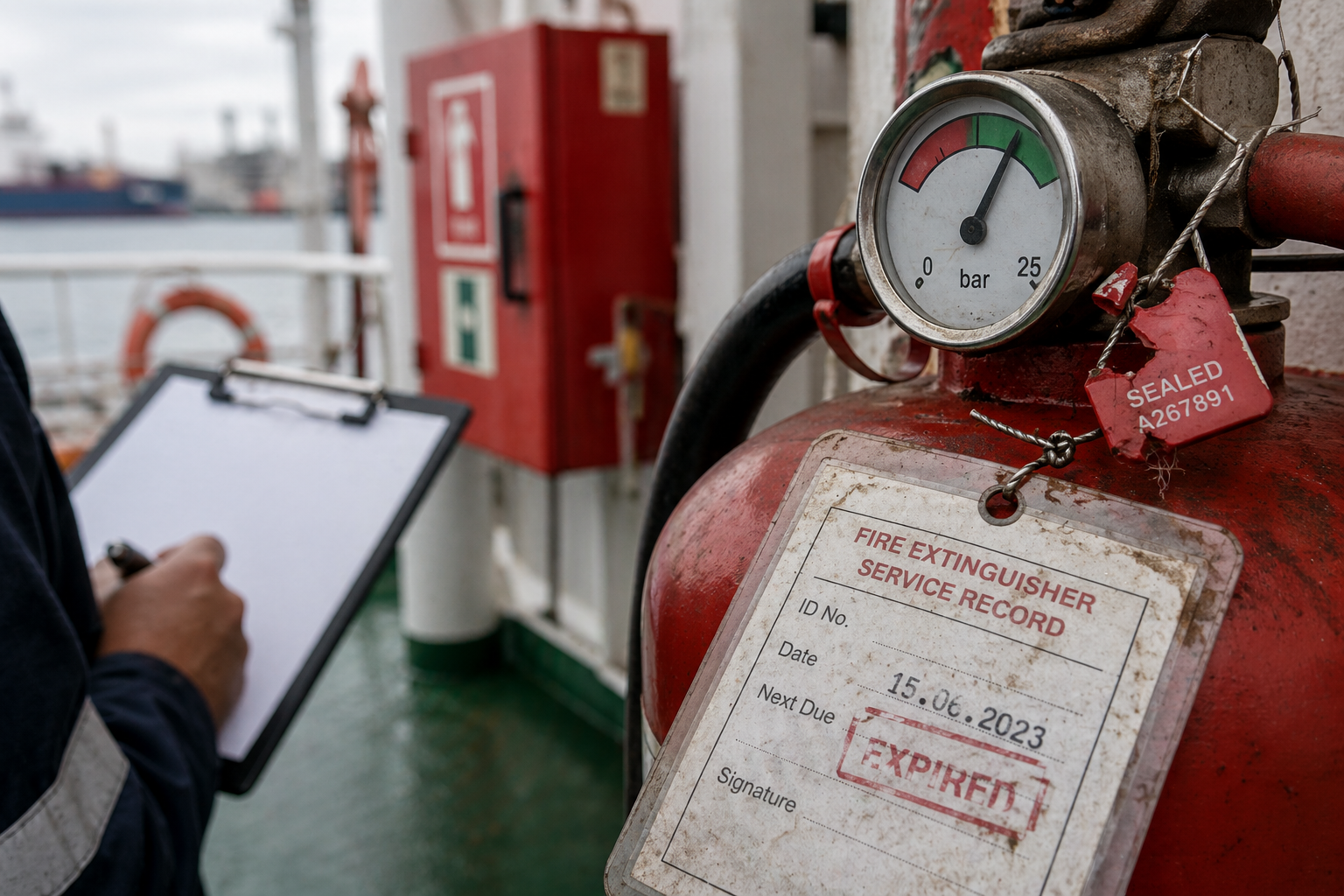
Port State Control rarely starts with something big.
It starts with annoying little things. A gauge needle sitting just outside the green. A missing seal. A service tag that does not match the record. And suddenly the whole ship is “interesting”.
This is the PSC logic: if basic safety details are sloppy, what else is hiding? Fair enough. But for shipowners and superintendents, it means one thing. Tiny defects can turn a routine call in Klaipėda or Gdynia into delays, extra questions, and a full inspection chain.
This post is a practical guide to the small defects that trigger bigger problems, and how to kill them before PSC steps onboard. It applies to Baltic ports first (Lithuania, Latvia, Estonia, Poland, Finland), and it holds the same way in Scandinavia and Western Europe (Norway, Sweden, Denmark, Germany, the Netherlands, Belgium, the UK, France, Spain, Portugal). Different inspectors. Same human pattern.
Why “small defects” get big attention
PSC does not have unlimited time. Inspectors look for quick indicators.
Portable extinguishers. SCBA/EEBD. Emergency signage. A few gauges. A few seals. A few logs.
If those items look wrong, the risk picture changes fast.
And once that happens, it is not about one extinguisher anymore. It is about your safety culture, your maintenance discipline, and whether your certificates can be trusted.
That is why ships get stuck on details. Not because PSC loves paperwork. Because details predict outcomes.
The small defects that start the chain
1) Pressure gauges that “almost pass”
The needle is close to the green zone. The gauge face is faded. The glass is cracked.
To the crew it looks “fine”. To PSC it looks like “not controlled”.
Fix: replace questionable gauges, verify correct charge/pressure for the agent type, and keep the readings consistent with the service record.
2) Missing tamper seals, broken pins, or improvised fixes
A missing seal is a loud message: “this extinguisher can’t be trusted”.
Same for missing safety pins, missing locking wire, or a seal that looks reused.
Fix: replace seals properly after service, don’t reuse, and keep the seal number or service reference traceable in your records.
3) Service tags that don’t match the log
Tag says one date. Record says another. Or the tag is present but the ship has no supporting certificate.
This is one of the fastest ways to trigger deeper questions.
Fix: align the tag date, the certificate date, and the ship record. If the operator changed, make sure documents transferred with the vessel.
4) Overdue hydrostatic tests and “silent” expiry dates
If the hydro test interval is exceeded, PSC does not care that the extinguisher “looks new”.
Overdue means non-compliance. Full stop.
Fix: keep a simple list: extinguisher ID, location, type, last service, hydro test due date. If you manage a mixed fleet, this list is worth its weight in fuel.
5) Wrong location, missing brackets, or poor accessibility
Extinguishers on the deck with no bracket. Hidden behind stores. Blocked by cargo gear.
PSC sees poor readiness.
Fix: correct mounting, correct signage, and clear access. The best extinguisher is useless when you can’t reach it in 10 seconds.
6) Wrong signage and wrong label language
Sign says CO₂, cylinder is dry powder. Or signage is missing entirely.
Small mismatch = big doubt.
Fix: check signage, match it to the agent type, and keep markings legible. If you trade widely, clear pictograms help across ports.
7) “Too clean” or “too dirty” cylinders
A cylinder covered in corrosion suggests neglect.
A cylinder that looks freshly painted can also raise questions if the serial/markings are unclear.
Fix: keep cylinders in good condition, but never hide markings. Serial number and approvals must remain readable.
8) Missing evidence photos and weak “class-ready” documentation
PSC is not class, but the same rule applies: evidence wins.
If you cannot show basic traceability, you get more questions.
Fix: keep a clean evidence pack. Photos of serials, service stickers, key readings, and certificates stored digitally. This is what makes a report “class accepted” on the first attempt and keeps PSC calm.
Paper that clears doubts (fast)
When PSC asks about portable extinguishers, your best answer is not a speech.
It is a folder. Clean, consistent, and easy to navigate.
Minimum set that works in real life:
- Current service certificates (by scope and date)
- Hydro test evidence (where applicable) and due dates
- A simple inventory list by location
- Clear link between tag/sticker and the certificate reference
- A short note on who serviced it (authorized provider, technician ID or traceable record)
If your company runs inspections under an ISO 9001 system, this becomes easier. ISO is not “more paper”. It is the ability to answer: who, when, what, and with what evidence.
Baltic case notes (Klaipėda, Gdynia, and the usual stories)
Most detentions do not start with a dramatic failure.
They start with silence.
In Klaipėda, we often see the same pattern: one extinguisher has a missing seal, the tag date is off, and the inventory list is outdated. The inspector asks for more. Then they look at SCBA logs. Then they walk the route again.
In Gdynia and Gdańsk, the trigger is often hydro test dates and inconsistent stickers. Not because the ship is unsafe. Because the ship cannot prove it is safe quickly.
And in Finland (Helsinki, Kotka, Turku), the expectation on documentation order and clarity is typically higher. The technical standard is similar. The tolerance for “messy proof” is lower.
Same lesson everywhere: small defects start the chain. Clean proof stops it.
Quick rectification pack (what to fix within hours)
When you are already alongside and PSC is due, you need a realistic “same-day” plan:
- Replace damaged gauges and missing seals
- Re-mount loose extinguishers and clear access
- Correct signage mismatches
- Update the inventory list and match tag/certificate references
- Build one digital PDF pack: certificates + inventory + due dates + key photos
This is why smart operators bundle FFE work during port calls.
A single firefighting equipment inspection in Baltic ports, done properly, often saves more time than it costs.
One more thing: why PSC “small defects” matter beyond PSC
PSC is not the enemy. It is a mirror.
Those little defects are not just “PSC triggers”. They are early warning lights.
If extinguishers are sloppy, what about lifeboat release gear? What about davit brakes? What about the evidence for your 110% SWL test? The logic is brutal, but it is consistent.
If you want the easiest life, keep the basics tight.
Then your bigger inspections, including MSC.402(96) lifeboat inspections and class acceptance, become smoother too.
Practical close
If you trade the Baltic corridor, treat portable extinguishers like your daily hygiene. Not glamorous, but it prevents pain.
Klaipėda, Riga, Tallinn, Gdynia, Gdańsk, Helsinki. Different ports, same reality.
And when you expand into Norway, Sweden, Denmark, Germany, the Netherlands, Belgium, the UK, and beyond, the same small defects will still trigger the same chain.
Fix the small stuff early.
Keep proof clean.
And you will rarely hear the words: “We need to look a bit deeper.”