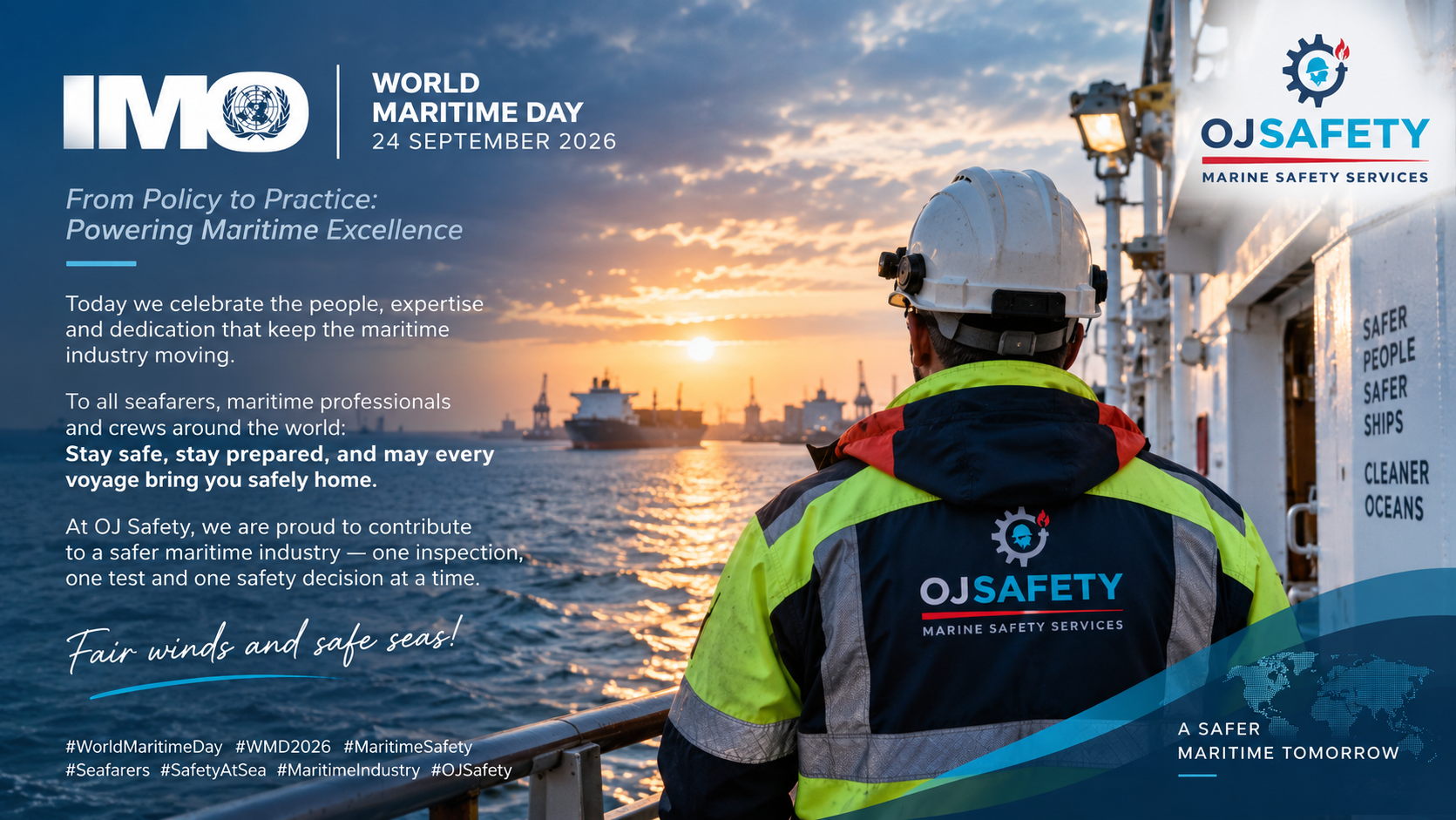
On 24 September 2026, the global maritime community marks World Maritime Day under the IMO theme:
“From Policy to Practice: Powering Maritime Excellence”
The theme is particularly relevant in 2026 because IMO has deliberately shifted the conversation from creating regulations to making sure they work in real maritime operations.
For the first time, the World Maritime Day theme will run for two years, covering 2026 and 2027. IMO describes the objective clearly: international maritime rules deliver value only when they are translated into national legislation, effective enforcement, technical competence and day-to-day operations onboard ships and ashore.
For shipowners, managers, superintendents and crews, that idea is very practical.
A regulation written in London does not stop a fire.
A certificate does not launch a lifeboat.
A maintenance procedure does not operate a davit.
People, equipment, training and correct implementation do.
What Does “From Policy to Practice” Mean for Ships?
Maritime safety operates through several layers.
IMO develops international conventions, codes, resolutions and guidance. Flag Administrations implement them. Classification Societies and Recognized Organizations support statutory compliance. Service suppliers inspect and maintain equipment. Ship managers plan the work. And ultimately, the crew must be able to use the equipment when it matters.
The chain only works when every part connects.
For example, MSC.402(96) establishes requirements for maintenance, thorough examination, operational testing, overhaul and repair of lifeboats, rescue boats, launching appliances and release gear.
But practical compliance still means identifying the correct equipment, confirming the service scope, verifying authorization, arranging competent technicians, coordinating Flag/Class requirements, completing the work and leaving traceable documentation onboard.
That is the difference between having a regulation and actually implementing it.
2026 Is a Real Year of Implementation
The theme is not just ceremonial language.
A significant package of IMO requirements entered into force on 1 January 2026.
Among them are new requirements covering onboard lifting appliances and anchor-handling winches under SOLAS II-1/3-13, amendments affecting lifeboat and rescue-boat servicing under MSC.402(96), new fire-safety provisions and a prohibition on the use or storage of firefighting media containing PFOS.
For existing ships, the PFOS prohibition must be complied with no later than the first relevant survey on or after 1 January 2026. IMO has also introduced additional fire-safety requirements for vehicle, special-category and ro-ro spaces.
This is exactly what “policy to practice” looks like.
A rule enters into force.
Then somebody has to determine whether it applies to the vessel, inspect the equipment, correct deficiencies, update documentation and make sure the crew understands the system.
That final stage is where maritime excellence is actually measured.
Why Maintenance and Testing Matter More Than Paperwork
Most serious safety equipment does not fail because somebody forgot that SOLAS exists.
Problems usually appear much closer to the deck plate:
A fire pump starts but cannot maintain pressure.
A davit brake holds an empty boat but behaves differently under load.
A release mechanism has excessive play.
An SCBA cylinder appears ready but its service history cannot be traced.
A fixed CO₂ system has documentation that no longer matches the physical installation.
A fire door has quietly become a permanent doorstop.
None of these problems is solved by adding another certificate to a folder.
Effective maritime safety means condition, function, documentation and crew readiness must tell the same story.
From Global Regulation to a European Port Call
Implementation also depends on logistics.
A vessel may have only a short operational window alongside. Annual LSA and FFE servicing, lifeboat and davit inspections, load testing, SCBA/EEBD checks, fixed firefighting systems and documentation may all need to be completed without affecting departure.
Whether the vessel is calling Klaipėda, Hamburg, Rotterdam, Esbjerg or Gothenburg, the principle remains the same:
The work should be planned before arrival.
Flag and Class requirements should be checked early.
Equipment details should be known.
Service-provider scope and technician competence should be verified.
And testing, repairs and documentation should be coordinated around the vessel’s real schedule.
Otherwise, “compliance planning” has an unfortunate habit of becoming “second mobilization planning”.
What Does Maritime Excellence Look Like in Practice?
It is rarely dramatic.
It looks like a lifeboat that launches correctly.
A davit brake that holds the required load without unacceptable drift.
An emergency fire pump that produces the required water supply.
An SCBA set that matches its service records.
A CO₂ system whose cylinders, release arrangements, alarms and documentation are in order.
And a crew member who knows exactly what to do when an inspector asks a simple question.
That is where IMO policy becomes operational safety.
The Human Side of Maritime Regulation
IMO Secretary-General Arsenio Dominguez has emphasized that putting policy into practice ultimately means people: seafarers, port personnel, ship operators, Port State Control officers, Flag State Administrations and the wider maritime community.
That matters.
Shipping has spent decades building one of the most detailed international regulatory systems in existence. But even the best regulations achieve little without competent people capable of applying them consistently.
Training, technical knowledge, maintenance culture, communication and professional judgement remain just as important as the rules themselves.
Technology will change.
Regulations will evolve.
Ships will become more automated.
But maritime safety will continue to depend on people turning requirements into reliable actions.
World Maritime Day 2026: The Practical Message
“From Policy to Practice” is a good description of what maritime safety should already be.
Not regulations for the sake of regulations.
Not inspections for the sake of inspections.
Not certificates for the sake of certificates.
The objective is simpler:
Equipment that works.
People who know how to use it.
Documentation that proves what was done.
And ships that can operate safely.
At OJ Safety, that is the part of maritime regulation we see every day: translating SOLAS, IMO, Flag and Class requirements into practical inspection, testing, servicing and vessel readiness.
From Klaipėda to Hamburg, Rotterdam, Esbjerg and Gothenburg, the principle remains unchanged.
Policy sets the standard. Practice makes the vessel safe.
Happy World Maritime Day 2026.