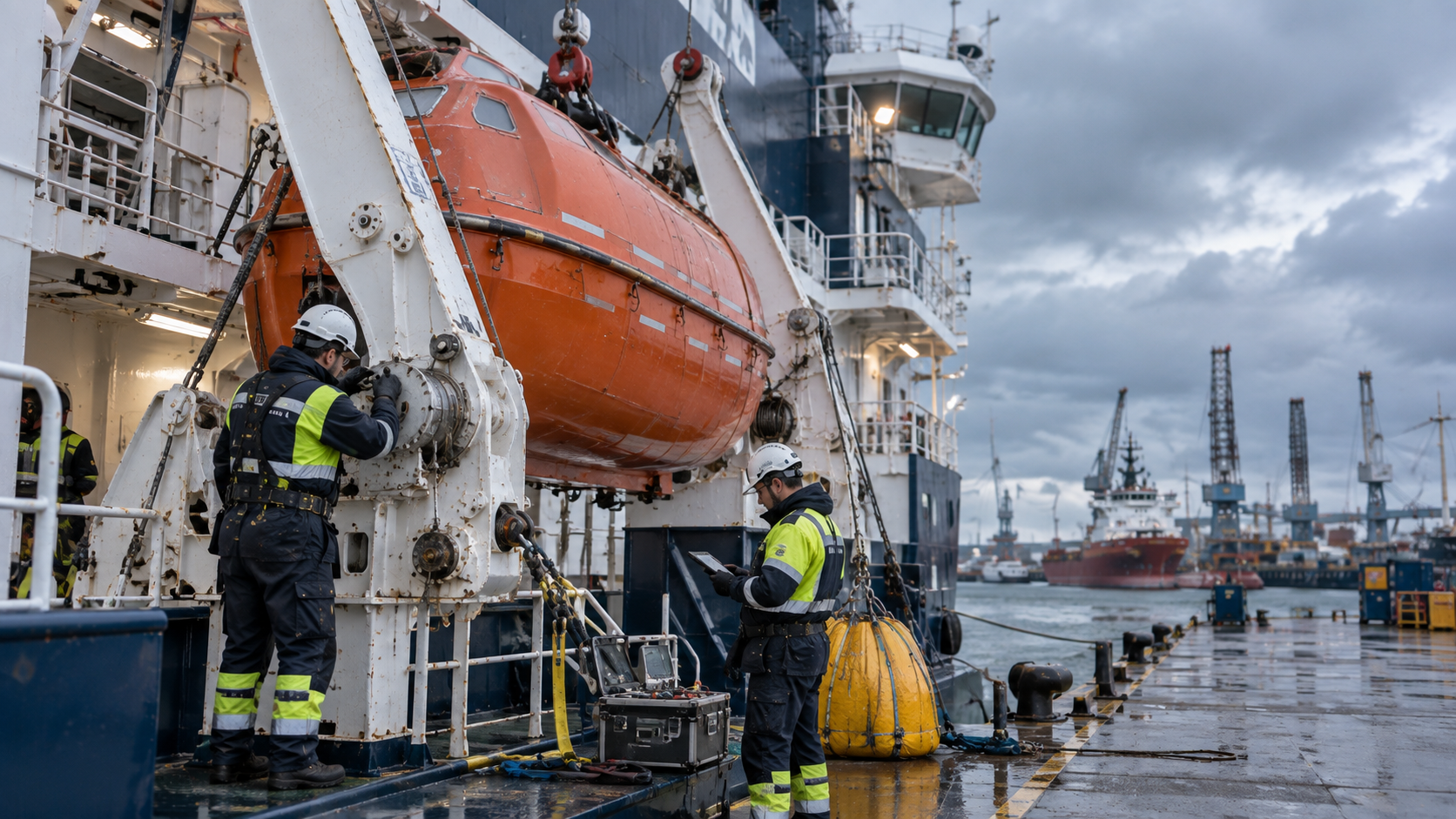
Davit and lifeboat load testing is one of the most misunderstood parts of LSA servicing.
A test is not complete simply because a load was applied and the equipment moved.
For shipowners, technical managers and superintendents, the real questions are:
- What load is actually required?
- When does 110% SWL apply?
- What must be checked on the davit, winch and brake?
- Does Class or Flag need to witness the test?
- Who is authorized to perform the work?
- What documentation must be available before the vessel sails?
For vessels calling European ports, these questions become operational as well as regulatory. A poorly planned test can turn a routine port call into additional attendance, missing documentation or delayed class acceptance.
This guide explains the practical framework for lifeboat and davit load testing in Europe, including annual and five-year requirements, 110% SWL testing, brake tests, Class/Flag involvement and certification.
Quick Answer: What Is a Davit Load Test?
A davit load test verifies that the launching appliance, winch, brake, falls, structural components and associated arrangements can safely operate under the required test condition.
Depending on the equipment, inspection interval and applicable requirement, testing may involve:
- operational testing of the launching appliance;
- winch and brake testing;
- examination of davit structure and foundations;
- inspection of falls, sheaves and associated components;
- testing with the required proof/test load;
- verification of release and recovery arrangements;
- recording of results for Flag/Class acceptance.
For lifeboats, rescue boats and their launching appliances, the applicable scope should be established against SOLAS Chapter III, MSC.402(96), the LSA Code, manufacturer instructions and Flag/Class requirements.
Important: not every annual inspection requires a 110% proof-load test. The exact test scope depends on the equipment, inspection interval and applicable statutory/Class requirements.
What Does 110% SWL Mean?
SWL means Safe Working Load.
A 110% SWL test applies a test load equal to 1.10 times the relevant safe working load.
For example:
| Rated SWL | 110% Test Load |
|---|---|
| 5,000 kg | 5,500 kg |
| 7,500 kg | 8,250 kg |
| 10,000 kg | 11,000 kg |
| 15,000 kg | 16,500 kg |
The important point is not the arithmetic. Even a calculator can survive that part.
The important point is determining which SWL applies, which component is being tested, what test condition is required and whether the test is required at all.
The test load must therefore be established from the approved equipment information, applicable requirements and manufacturer documentation before the test begins.
When Is 110% SWL Load Testing Required?
The most common confusion is treating annual inspection, five-year inspection and proof-load testing as interchangeable terms.
They are not.
Annual inspection
An annual lifeboat and davit inspection normally concentrates on condition and operational functionality, including relevant examinations and operational tests required by the applicable regime.
It does not automatically mean that the complete launching appliance must undergo a 110% SWL proof-load test every year.
Five-year inspection
The five-year examination is considerably deeper.
Depending on the installation and applicable requirements, it can include:
- detailed examination of launching appliances;
- winch inspection;
- brake examination and testing;
- release gear examination/overhaul;
- operational testing;
- testing with the specified load;
- examination of structural and mechanical components;
- certification and supporting test records.
Under MSC.402(96), five-year servicing of lifeboats, rescue boats, launching appliances and release gear is subject to specific requirements concerning competent personnel and authorized service providers.
The exact test arrangement must always be confirmed against the vessel’s equipment, Flag, Class and manufacturer requirements.
Davit Load Testing: What Is Actually Checked?
A competent load test is not simply:
attach load → operate winch → issue certificate.
The launching system must be considered as an assembly.
1. Davit Structure
Before loading, technicians should examine the visible condition of relevant structural components.
Typical points include:
- davit arms;
- foundations and attachment points;
- welds and accessible structural connections;
- sheaves;
- pins and pivot points;
- corrosion or deformation;
- hydraulic components where fitted;
- limit switches and controls where applicable.
Applying proof load to visibly defective equipment is not an inspection methodology. It is an unusually expensive way of discovering physics.
2. Winch Condition
The winch is a critical part of the launching arrangement.
Inspection may include:
- general mechanical condition;
- drum condition;
- wire arrangement;
- gearing;
- lubrication;
- controls;
- brake components;
- abnormal movement or noise;
- evidence of leakage, corrosion or deterioration.
Any defect affecting safe operation should be addressed before proceeding with the relevant loaded test.
3. Falls and Sheaves
Falls are part of the load path and cannot be treated as background scenery.
Checks should consider:
- wire rope condition;
- corrosion;
- broken wires;
- deformation;
- termination arrangements;
- reeving;
- sheave condition;
- lubrication;
- alignment;
- replacement history where relevant.
The service history should also correspond with the physical equipment actually installed onboard.
Brake Testing: Why “No Drift” Matters
One of the critical elements of launching-appliance testing is winch brake performance.
The brake must control and hold the relevant load as required by the applicable test procedure.
Technicians therefore look for indications such as:
- uncontrolled lowering;
- brake slippage;
- creeping or drift;
- abnormal brake behaviour;
- excessive vibration;
- inconsistent stopping;
- inability to hold the required load.
A brake that appears satisfactory with an empty boat may behave very differently when subjected to the required loaded condition.
That is precisely why loaded testing exists.
Static Hold vs Dynamic Brake Test
These are related but different concepts.
Static hold
The system is placed under the specified load condition and observed to determine whether the brake and associated arrangement maintain the load without unacceptable movement.
Dynamic test
The launching appliance is operated under the required loaded condition and the brake performance is tested in accordance with the applicable procedure.
The exact method must follow the relevant statutory requirements, manufacturer instructions and Flag/Class requirements.
This distinction matters because a certificate merely stating “load test satisfactory” may provide very little evidence of what was actually performed.
How Is the Test Load Applied?
Several methods may be used depending on the equipment and approved test procedure.
A common method involves calibrated water bags or equivalent test weights.
Water bags are useful because the load can be built progressively and controlled on site.
A typical operation may involve:
- confirming the required test load;
- checking the equipment and test arrangement;
- positioning test equipment;
- connecting calibrated load-measuring equipment where applicable;
- gradually applying the required load;
- verifying the achieved test load;
- performing the required operational/brake test;
- safely removing the load;
- conducting a post-test examination;
- recording results and supporting evidence.
The actual procedure must be adapted to the davit design, vessel arrangement, manufacturer’s instructions and approved testing requirements.
Load Measurement and Calibration
A test certificate is only as credible as the evidence behind the number printed on it.
Where measuring equipment is used, traceability matters.
Typical supporting records may include:
- load-cell identification;
- calibration certificate;
- calibration validity;
- test-equipment identification;
- recorded applied load;
- photographs of the test arrangement;
- equipment serial numbers;
- technician/service-provider details.
For Class or Flag review, “approximately 110%” is not an especially inspiring engineering measurement.
The applied test load should be demonstrable and documented.
Does Class Need to Witness a Davit Load Test?
Not automatically in every case.
Whether a Class surveyor must attend depends on factors such as:
- Flag State requirements;
- Classification Society requirements;
- statutory survey timing;
- type of inspection or test;
- equipment history;
- repairs or modifications;
- previous deficiencies;
- scope of the vessel’s survey.
For some five-year examinations or tests, Class/Flag attendance or acceptance may be required.
For other cases, work performed by an appropriately authorized service provider with the required documentation may be accepted without physical Class attendance.
Practical rule for ship managers
Do not arrange the test first and ask Class afterwards.
Before mobilization, confirm:
Flag → Class → equipment → required scope → witness requirement → service-provider authorization → documentation.
That five-minute administrative sequence can prevent a second attendance.
Service Provider Authorization: Who Can Perform the Test?
For equipment falling within MSC.402(96), personnel and service providers performing maintenance, thorough examination, operational testing, overhaul and repair must meet the applicable authorization and competence requirements.
The acceptance chain can involve:
Manufacturer → Service Provider → Flag State → Recognized Organization/Class → Vessel
These are not interchangeable approvals.
A company being technically capable of applying a test load does not automatically mean its work will be accepted for every vessel, Flag and Class.
Before booking, the superintendent should verify:
- service-provider authorization;
- technician competence/certification;
- equipment/manufacturer coverage where applicable;
- Flag acceptance;
- Class acceptance;
- required surveyor attendance.
This should be done before the vessel arrives in port.
What Documentation Should Be Issued After Load Testing?
The documentation package is almost as important as the physical test.
A proper file should clearly identify what was tested and how.
Depending on scope, the package may include:
Test certificate
Typically identifying:
- vessel;
- IMO number;
- equipment;
- manufacturer;
- model/type;
- serial number;
- SWL;
- applied test load;
- test date;
- test location;
- result;
- technician/service provider.
Service or inspection report
This should describe the work actually performed rather than merely repeat the word “satisfactory”.
Calibration evidence
Where relevant:
- load-cell certificate;
- measuring-equipment calibration;
- identification of test equipment.
Photographic evidence
Useful photographs can demonstrate:
- equipment identity;
- test setup;
- load arrangement;
- measurement;
- brake/winch test;
- general equipment condition.
Supporting authorization
Where required, evidence of service-provider and technician authorization should be available for Flag/Class review.
Common Reasons Davit Load Tests Are Rejected or Questioned
In practice, problems often arise from documentation and preparation rather than catastrophic equipment failure.
Typical issues include:
- incorrect SWL used for calculation;
- unclear test load;
- expired calibration certificate;
- equipment serial numbers missing;
- service-provider authorization not confirmed;
- technician scope not demonstrated;
- insufficient photographs;
- test method not clearly recorded;
- brake performance not documented;
- Class witness required but not arranged;
- Flag-specific requirements overlooked;
- certificate details not matching onboard equipment.
A technically successful test with weak documentation can still create a compliance problem.
For the superintendent, that distinction is academic. The vessel still has a problem to solve.
Pre-Test Checklist for Superintendents
Before arranging lifeboat or davit load testing in a European port, confirm:
| Item | Check |
|---|---|
| Vessel / IMO | Correct |
| Lifeboat/rescue boat type | Identified |
| Davit manufacturer/model | Identified |
| Winch manufacturer/model | Identified |
| SWL | Confirmed |
| Required test load | Confirmed |
| Annual or five-year scope | Confirmed |
| Manufacturer instructions | Available |
| Flag requirements | Checked |
| Class requirements | Checked |
| Class witness | Confirmed if required |
| Service-provider authorization | Verified |
| Technician competence | Verified |
| Test equipment/calibration | Valid |
| Port/yard access | Arranged |
| Final documentation | Agreed before attendance |
This is considerably cheaper than discovering one missing requirement with the vessel already alongside.
Davit & Lifeboat Load Testing in European Ports
For ship managers operating across Europe, location matters because the testing window is normally dictated by the vessel’s schedule.
Typical operational areas include:
- Klaipėda
- Riga / Liepāja / Ventspils
- Tallinn
- Gdańsk / Gdynia / Szczecin
- Helsinki / Kotka / Turku
- Copenhagen / Esbjerg
- Gothenburg
- Hamburg
- Rotterdam
- Antwerp
- Norwegian ports
- North Sea ports
The practical objective should be to combine the required LSA inspection, davit/winch examination, load testing and documentation within the same port-call or shipyard window wherever possible.
Mobilization planning is therefore part of compliance planning.
Can Lifeboat Inspection and Load Testing Be Combined?
Yes, and in many cases they should be coordinated.
A planned attendance may combine relevant elements such as:
- annual or five-year lifeboat inspection;
- rescue boat inspection;
- davit inspection;
- winch examination;
- brake testing;
- release gear examination;
- proof-load testing where required;
- repairs;
- final certification.
This reduces duplicated mobilization, repeated vessel access and the risk that separate contractors produce documentation that does not align.
For fleet managers, the same principle can be extended across multiple vessels by monitoring due dates and matching inspections to planned European port calls.
Annual Inspection vs Five-Year Load Test: Quick Comparison
| Requirement | Annual | Five-Year |
|---|---|---|
| General lifeboat examination | Yes | Yes, detailed |
| Davit examination | Yes | Detailed |
| Winch examination | Yes | Detailed |
| Operational testing | Yes, as applicable | Yes |
| Release gear scope | Applicable checks | Thorough examination/overhaul as applicable |
| Loaded brake testing | As required by applicable regime | Required scope applies |
| 110% SWL proof/load test | Not automatically every annual | Applicable five-year testing requirements |
| Authorization | MSC.402(96) requirements apply | MSC.402(96) requirements apply |
| Class/Flag involvement | Depends on vessel/scope | Often greater; verify |
| Documentation | Required | Detailed certification package |
Always verify the vessel-specific requirement with Flag/Class and manufacturer instructions.
Frequently Asked Questions
Is a davit 110% SWL test required every year?
No. Annual inspection should not automatically be confused with periodic proof/load testing. The required scope depends on the equipment, inspection interval and applicable statutory, Flag, Class and manufacturer requirements.
What does 110% SWL mean?
It means a test load equal to 110% of the applicable Safe Working Load. A 10,000 kg SWL therefore corresponds to an 11,000 kg test load where a 110% test is required.
Is an empty lifeboat sufficient for brake testing?
Not where the applicable test procedure requires the brake to be tested under a specified loaded condition. The correct test condition must be established from the applicable requirements.
Can water bags be used for davit load testing?
They are commonly used where suitable for the approved test arrangement because the load can be progressively controlled and measured.
Does Class always need to witness the test?
No. Witness requirements depend on Flag, Class, survey scope and the work being performed. Confirm this before attendance.
Can any marine service company perform the test?
Technical capability alone is not sufficient. Where MSC.402(96) applies, authorization and personnel competence requirements must be satisfied, together with relevant Flag/Class acceptance.
What happens if the brake drifts during the test?
The result requires investigation. The brake or associated winch system may require adjustment, repair or further examination before satisfactory completion and certification.
What certificates should the vessel receive?
The exact package depends on scope, but normally includes clear test/inspection records identifying the equipment, SWL, applied test load, result, date, location and responsible service provider, together with relevant supporting calibration and authorization records.
OJ Safety: Davit and Lifeboat Load Testing Support in Europe
OJ Safety provides lifeboat, rescue boat, davit and winch inspection and testing support for commercial and offshore vessels operating in the Baltic, Scandinavia, North Sea and selected Western European ports.
Scope can include:
- annual and five-year LSA inspection;
- lifeboat and rescue boat inspection;
- davit and winch examination;
- brake testing;
- release gear inspection;
- 110% SWL/load testing where applicable;
- test-equipment coordination;
- inspection and certification documentation;
- Flag/Class coordination support.
For vessel-specific attendance, the scope should be confirmed against the equipment manufacturer, Flag State and Classification Society requirements before mobilization.
OJ Safety
Klaipėda, Lithuania | European mobilization
www.ojsafety.com
Conclusion
Successful davit and lifeboat load testing is not about hanging weight from a launching appliance and obtaining a piece of paper.
Four things must align:
correct test scope + correct load + accepted service provider + accepted documentation.
For vessels operating across European ports, the best time to resolve Flag, Class, authorization and witness requirements is before the port call.
Because discovering that the test was technically correct but administratively unacceptable after completion is a particularly maritime way of paying for the same job twice.