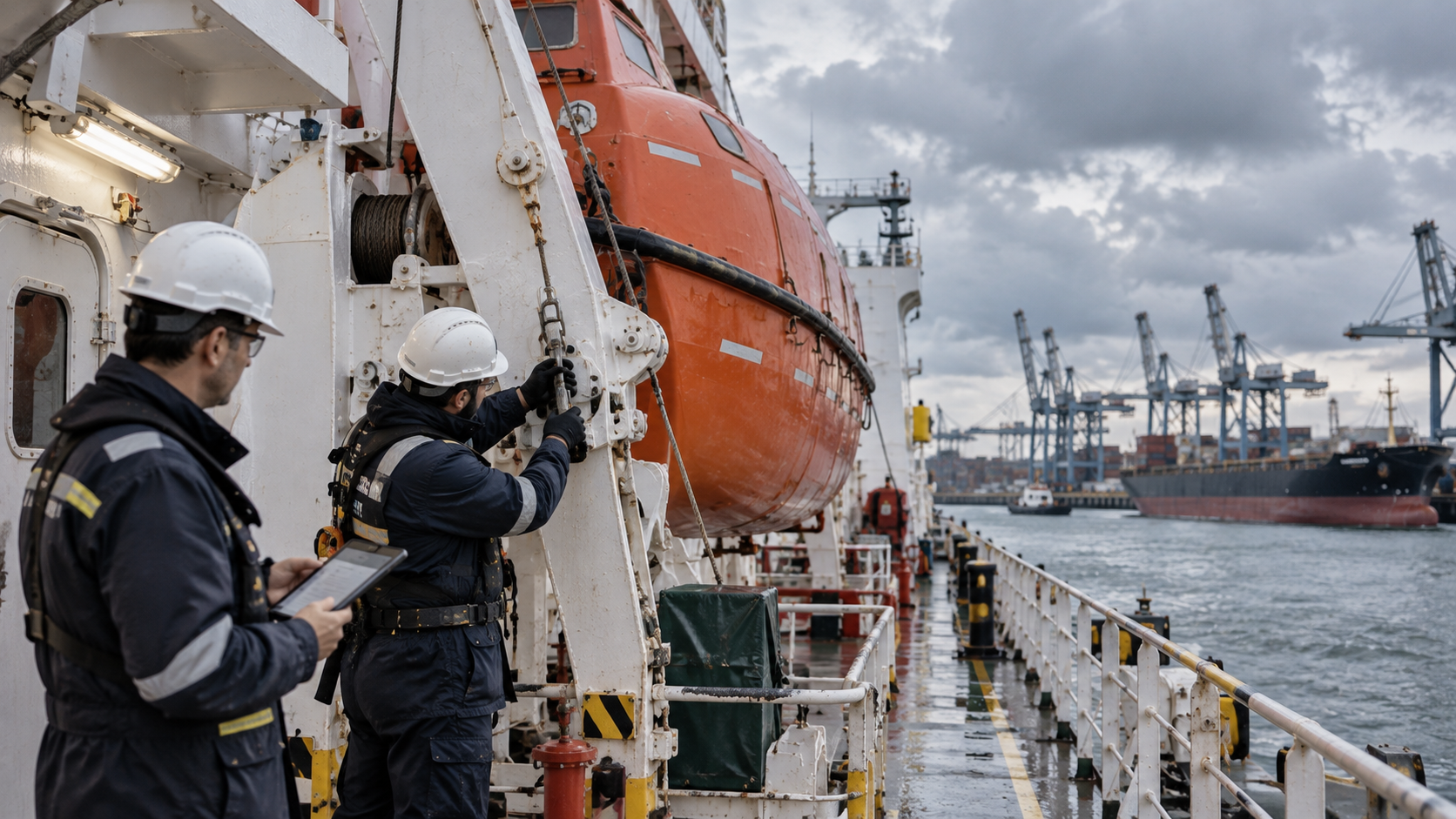
For shipowners and vessel managers, arranging a lifeboat inspection in Europe is not simply a question of finding a service company in the nearest port.
Under IMO Resolution MSC.402(96) and SOLAS Chapter III, the inspection must match the required interval, equipment type, service-provider authorization, personnel certification and applicable Flag/Class requirements.
The practical question is therefore not only:
“Can you inspect our lifeboat?”
It is:
“Can you perform the required MSC.402(96) scope on this specific lifeboat, davit and release gear, and will the documentation be accepted by the vessel’s Flag and Class?”
MSC.402(96) became mandatory under SOLAS on 1 January 2020. It establishes requirements for maintenance, thorough examination, operational testing, overhaul and repair of lifeboats, rescue boats, launching appliances and release gear.
What Is IMO Resolution MSC.402(96)?
IMO Resolution MSC.402(96) establishes a uniform, safe and documented standard for servicing:
- lifeboats, including free-fall lifeboats;
- rescue boats and fast rescue boats;
- launching appliances;
- davits and winches;
- on-load and off-load release gear;
- launching arrangements for davit-launched liferafts.
The Resolution is connected directly with SOLAS Regulation III/20 – Operational Readiness, Maintenance and Inspections and SOLAS Regulation III/36 concerning instructions for onboard maintenance.
The requirements cover several different levels of work, including routine maintenance, annual thorough examination and operational testing, five-year thorough examination, overload testing, overhaul and repair.
This distinction matters because not every task can be performed by the same personnel under the same conditions.
Annual vs Five-Year Lifeboat Inspection
One of the most common questions from ship managers is:
What is the difference between an annual and a five-year lifeboat inspection under MSC.402(96)?
The annual examination is a thorough condition and operational assessment of the equipment.
The five-year examination includes the applicable annual scope but adds specific five-year requirements, including overload operational testing and other procedures specified by MSC.402(96 and the manufacturer’s technical documentation.
| Requirement | Annual Inspection | Five-Year Inspection |
|---|---|---|
| Thorough examination | Yes | Yes |
| Operational testing | Yes | Yes |
| Lifeboat condition check | Yes | Yes |
| Davit/winch examination | Yes | Yes |
| Release gear examination | Yes | Yes |
| Review of onboard records | Yes | Yes |
| Overload operational testing | Not routine annual scope | Yes, as specified |
| Overhaul | If required | Where applicable |
| Certified personnel | Required | Required |
| Manufacturer or Authorized Service Provider | Required | Required |
| Flag/Class verification | As applicable | As applicable |
The exact scope must always be checked against the equipment manufacturer’s maintenance manual, MSC.402(96), vessel Flag requirements and applicable Class/RO procedures.
What Is Checked During an Annual MSC.402(96) Inspection?
The annual examination starts with the relevant weekly and monthly inspection items required under SOLAS.
Inspection and maintenance records maintained onboard are reviewed together with applicable equipment certificates.
For lifeboats, rescue boats and fast rescue boats, the examination includes, as applicable:
- boat structure and equipment;
- engine and propulsion system;
- manoeuvring system;
- power supply;
- sprinkler system;
- air supply system;
- bailing arrangements;
- fender and skate arrangements;
- rescue boat righting system.
But the boat itself is only part of the inspection.
The complete survival craft arrangement must be considered.
Lifeboat Davit and Winch Inspection
The launching appliance is a critical part of the MSC.402(96) inspection.
Depending on the installation and required scope, the examination covers items such as:
- davit structure;
- falls and associated arrangements;
- sheaves and moving components;
- winch;
- brake system;
- limit switches;
- stored mechanical power arrangements;
- hydraulic systems where fitted;
- controls;
- foundations and securing arrangements;
- lowering and recovery operation.
Operational testing is particularly important because equipment that appears satisfactory while static may behave very differently under load.
For this reason, davit brake performance and controlled lowering are not paperwork exercises.
They demonstrate whether the launching system can actually perform its safety function.
Release Gear Inspection Under MSC.402(96)
Release mechanisms receive particular attention because incorrect maintenance, adjustment or resetting can create serious risks during drills and emergency operations.
MSC.402(96) requires examination of relevant components including:
- release activation devices;
- excessive free play and tolerances;
- hydrostatic interlock systems, where fitted;
- control and release cables;
- hook fastening arrangements.
Operational testing of on-load and off-load release functions is also included where applicable.
The IMO requirements specifically emphasize that setting and maintenance of release gear are critical operations and that maintenance or adjustment must not be undertaken while hooks are under load.
For ship managers, this is also why the exact manufacturer and model of the release mechanism should be identified before arranging attendance.
What Happens During the Five-Year Lifeboat Inspection?
The five-year examination is more extensive than the normal annual inspection.
Under MSC.402(96), the five-year scope includes the applicable thorough examination requirements together with overload operational testing, and overhaul where required.
This can involve testing of:
- lifeboat launching appliances;
- rescue boat launching appliances;
- winches and brakes;
- release gear;
- associated safety arrangements.
The required test loads and procedure depend on the equipment and applicable regulatory/manufacturer requirements.
For practical planning, five-year inspections should therefore be treated differently from ordinary annual attendance.
The vessel manager should confirm test arrangements, load-testing equipment, service-provider authorization, certified personnel and any required Class/RO attendance before the vessel reaches port.
Discovering that one of these elements is missing after technicians and water bags are already alongside is an expensive way to study SOLAS.
Who Can Perform an MSC.402(96) Lifeboat Inspection?
This is one of the most important parts of MSC.402(96).
For annual thorough examinations and operational tests, the work must be performed by certified personnel of the manufacturer or an Authorized Service Provider.
Five-year thorough examinations, overload operational tests, overhaul and repairs are likewise assigned to appropriately certified personnel of the manufacturer or an Authorized Service Provider.
MSC.402(96) defines an Authorized Service Provider as an entity authorized by the Administration in accordance with the Resolution.
This creates three separate questions that should be checked before mobilization:
1. Is the service provider appropriately authorized?
2. Does its authorization cover the required service and equipment?
3. Are the technicians performing the work appropriately certified for that scope?
A company certificate alone should therefore never be treated as the entire compliance check.
Does MSC.402(96) Require the Original Equipment Manufacturer?
No. MSC.402(96) does not require every annual or five-year inspection to be performed directly by the original equipment manufacturer.
The Resolution permits work to be carried out by appropriately certified personnel of either:
- the manufacturer; or
- an Authorized Service Provider.
In fact, when adopting MSC.402(96), IMO specifically invited governments to help ensure that equipment, instructions, specialized tools, spare parts, training and other necessary resources are available to independent service providers in a timely and cost-effective manner.
However, this does not mean that any independent marine service company can inspect any lifeboat.
The authorization and personnel certification must cover the applicable work and equipment.
Is Class Approval Enough for an MSC.402(96) Inspection?
Not automatically.
This is where vessel managers should distinguish between several layers of compliance:
IMO / SOLAS → Flag Administration → Recognized Organization / Class → Authorized Service Provider → Certified Personnel
MSC.402(96) establishes the international framework, but the vessel operates under a specific Flag Administration, which may delegate statutory functions to a Recognized Organization and may impose its own recognition or authorization arrangements.
Therefore:
Class approval of a service supplier should not automatically be interpreted as universal acceptance for every vessel and every Flag.
Before attendance, the vessel manager should verify:
- vessel Flag;
- Classification Society / Recognized Organization;
- service-provider authorization;
- authorization scope;
- technician certification;
- lifeboat manufacturer and model;
- davit/winch manufacturer and model;
- release gear manufacturer and model;
- required inspection interval.
Where applicable, requirements should be confirmed with the vessel’s Flag and Class before mobilization.
Does Class Need to Attend a Five-Year Lifeboat Inspection?
There is no sensible universal answer of simply “yes” or “no” for every vessel.
Survey attendance should be determined from the applicable Flag Administration and Recognized Organization/Class requirements.
Five-year examinations and overload testing are significant statutory activities, and Class/RO attendance may be required under the applicable procedures.
The safe planning rule is therefore simple:
Never assume surveyor attendance requirements. Confirm them before fixing the service date.
This becomes particularly important when the five-year inspection is being performed during a short port call or docking window.
What Documentation Should Remain Onboard After MSC.402(96) Inspection?
Documentation is part of the inspection, not something added afterwards.
MSC.402(96) requires reports and checklists to be completed and signed by the person performing the work and countersigned by the Company representative or Master.
Records covering maintenance, thorough examinations, operational testing, overhaul and repair must be maintained onboard for the service life of the equipment.
Following completion of the applicable work, the manufacturer or Authorized Service Provider must issue a statement confirming that the lifeboat arrangements remain fit for purpose, together with copies of valid certification and authorization documents as appropriate.
A practical inspection documentation package may therefore include:
- signed service report;
- completed inspection checklist;
- statement confirming fitness for purpose;
- Authorized Service Provider documentation;
- technician certification;
- operational test records;
- load-test documentation where applicable;
- calibration records for test equipment;
- supporting photographs where appropriate;
- records of defects, repairs and replacement parts;
- Class/RO documentation where required.
Good documentation should allow a superintendent, surveyor or PSC officer to reconstruct what was inspected, who performed the work, under what authorization and what the test results were.
MSC.402(96) Lifeboat Inspection in European Ports
For vessels trading in Europe, the technical requirements are only half of the problem.
The other half is logistics.
A vessel may need its annual or five-year LSA inspection completed during a limited port call in the Baltic, Scandinavia or North Sea region.
Typical operational locations include:
Baltic Sea: Klaipėda, Riga, Liepāja, Ventspils, Tallinn, Gdańsk, Gdynia and Szczecin.
Finland and Scandinavia: Helsinki, Kotka, Turku, Copenhagen, Esbjerg, Gothenburg and other regional ports.
North Sea and Western Europe: Hamburg, Rotterdam, Antwerp, Aberdeen and surrounding maritime hubs.
For short port calls, preparation should begin before arrival.
The objective is not merely to put technicians onboard quickly. It is to make sure the correct technicians, authorization, equipment, spares, test arrangements and documentation are available when the vessel is actually alongside.
Information Required Before Arranging Lifeboat Inspection
For faster confirmation of an MSC.402(96) inspection, vessel managers should provide:
- Vessel name and IMO number
- Flag Administration
- Classification Society / RO
- Required inspection: annual or five-year
- Lifeboat manufacturer, type and model
- Davit and winch manufacturer/model
- Release gear manufacturer/model
- Previous inspection/service reports
- Relevant certificates and due dates
- Port, ETA/ETD and available working window
Photographs of equipment nameplates are particularly useful when model information in vessel records is incomplete.
This allows the required scope and authorization to be checked before mobilization rather than after boarding.
MSC.402(96) Inspection Planning: The Practical Rule
For a superintendent arranging an annual or five-year lifeboat inspection in Europe, the safest sequence is:
Identify the equipment → define the inspection scope → verify authorization → verify personnel certification → confirm Flag/Class requirements → arrange attendance → complete testing → retain traceable documentation onboard.
Changing that order usually creates unnecessary cost.
The cheapest service quotation is irrelevant if the attending company cannot provide documentation acceptable to the vessel’s Flag or Class.
Likewise, the best-qualified service station is of limited use if technicians arrive after the vessel sails.
Compliance and logistics have to be planned together.
Frequently Asked Questions About MSC.402(96)
What is MSC.402(96)?
MSC.402(96) is the IMO Resolution establishing requirements for maintenance, thorough examination, operational testing, overhaul and repair of lifeboats, rescue boats, launching appliances and release gear. The associated SOLAS requirements became mandatory on 1 January 2020.
Is MSC.402(96) mandatory in Europe?
Yes, for SOLAS ships to which the relevant requirements apply. MSC.402(96) forms part of the mandatory SOLAS framework. Individual vessels must additionally comply with applicable Flag Administration and Recognized Organization/Class requirements.
Who can perform an annual MSC.402(96) lifeboat inspection?
Annual thorough examinations and operational tests must be performed by appropriately certified personnel of the manufacturer or an Authorized Service Provider in accordance with MSC.402(96).
Who can perform a five-year lifeboat inspection?
Five-year thorough examinations, applicable overload operational tests, overhaul and repairs must be carried out by appropriately certified personnel of the manufacturer or an Authorized Service Provider.
What is the difference between annual and five-year lifeboat inspections?
The annual inspection concentrates on thorough examination and operational testing. The five-year scope includes additional requirements such as applicable overload operational testing and overhaul requirements. The exact scope depends on the equipment and applicable technical and regulatory requirements.
Does MSC.402(96) require an OEM technician?
Not necessarily. MSC.402(96) permits appropriately certified personnel of an Authorized Service Provider to perform the applicable work. Authorization scope and personnel certification must nevertheless be suitable for the equipment and service being performed.
Can a non-OEM service provider inspect a lifeboat?
Yes, provided the service provider and personnel meet the applicable MSC.402(96) authorization and certification requirements for the relevant scope and equipment, and the arrangement is acceptable under the applicable Flag/Class framework.
Is Class approval enough for every Flag State?
It should not be assumed. Acceptance depends on the applicable Flag Administration and RO/Class arrangements. Verify the service provider’s authorization and scope against the vessel’s Flag and Class requirements before attendance.
Does a Class surveyor need to attend the five-year inspection?
Class/RO attendance depends on the applicable Flag and Class requirements and the work being performed. It should be confirmed before arranging the five-year examination and overload testing.
What documents are required after MSC.402(96) inspection?
The onboard package should contain the applicable signed reports and checklists, statement confirming fitness for purpose, and valid certification/authorization documentation. Test records, calibration evidence, repair records and Class/RO documentation should also be retained where applicable. MSC.402(96) specifically requires service records to be maintained onboard for the service life of the equipment.
MSC.402(96) Lifeboat Inspection Support in Europe
OJ Safety provides LSA inspection and servicing support for vessels operating across the Baltic, Scandinavian and wider European region, including lifeboats, rescue boats, davits, winches, release gear and associated testing.
For planning, send:
Vessel / IMO | Flag | Class | Port | ETA/ETD | Annual or 5-Year | Lifeboat/Davit/Release Gear details
This allows the applicable inspection scope, documentation and attendance requirements to be reviewed before the vessel arrives.
Regulatory basis: SOLAS Chapter III, including Regulation III/20, and IMO Resolution MSC.402(96). Always verify vessel-specific Flag and Class/RO requirements where applicable.
Last reviewed: September 2026