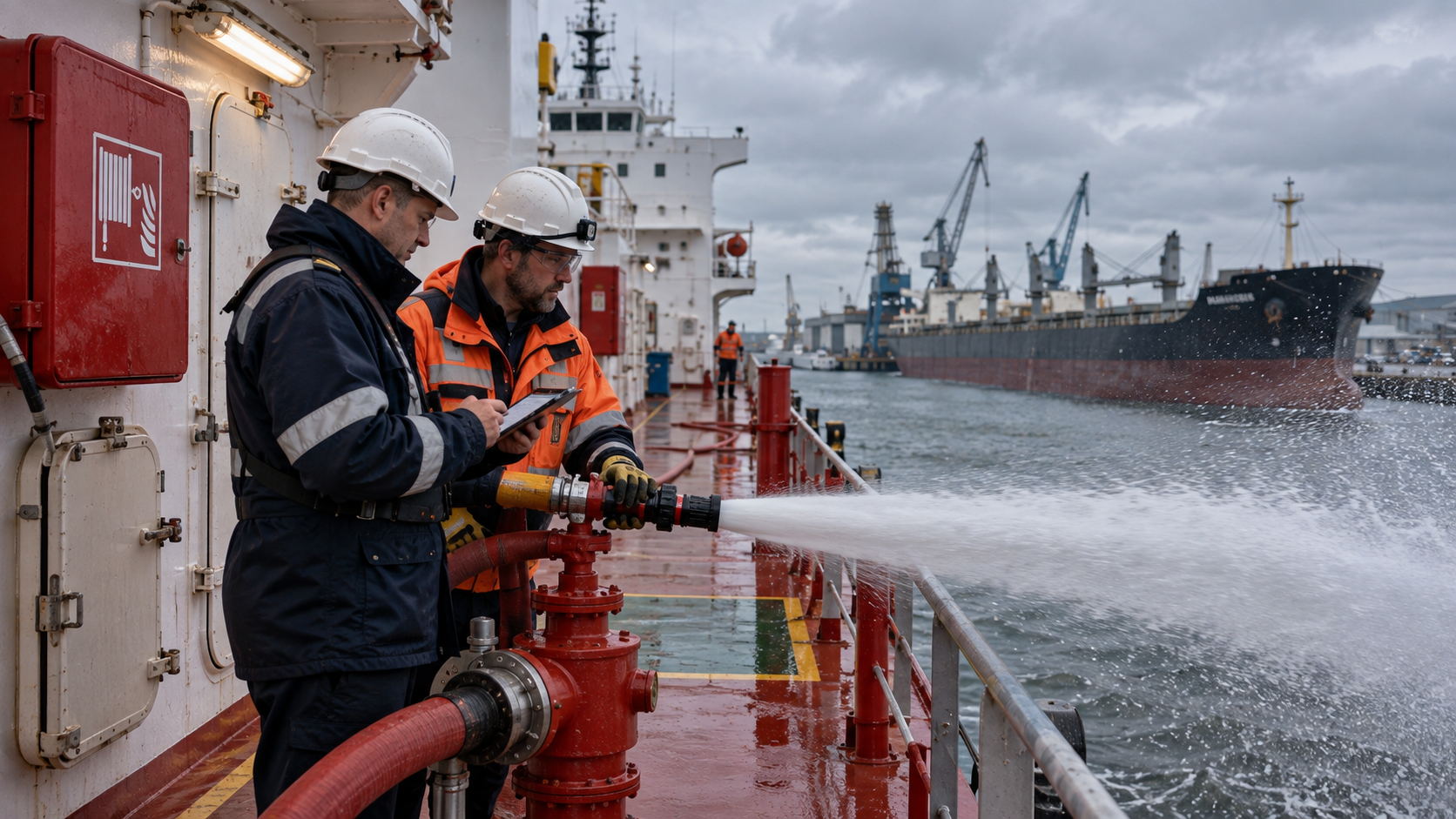
PSC Fire Safety Inspection: 15 Checks That Commonly Lead to Deficiencies or Detention
Fire safety remains one of the most important areas during a Port State Control (PSC) inspection.
A vessel may have valid statutory certificates and recently serviced firefighting equipment, but PSC officers do not assess certificates alone. They may verify whether fire protection systems are operational, accessible, correctly maintained, properly documented and familiar to the crew.
This matters because relatively small defects can expose a wider failure in the vessel’s fire-safety readiness.
Paris MoU’s 2023 Concentrated Inspection Campaign (CIC) on Fire Safety covered 3,856 inspections and resulted in 151 detentions. Fire doors, fire detection systems, fixed firefighting installations, firefighting equipment, ventilation, fire pumps and crew performance all appeared among recorded deficiency categories.
Below are 15 areas shipowners, technical managers, DPAs, superintendents and Masters should verify before the next PSC inspection.
What does PSC check during a fire safety inspection?
PSC may examine both the technical condition of firefighting systems and the vessel’s ability to use them effectively.
The regulatory framework is primarily based on SOLAS Chapter II-2, the International Code for Fire Safety Systems (FSS Code) and applicable IMO maintenance guidance, including MSC.1/Circ.1432, together with Flag State, Classification Society and manufacturer requirements where applicable. SOLAS II-2 covers prevention, detection, containment, firefighting, escape and operational readiness.
In practical terms, the inspector is trying to establish something simple:
If a fire starts now, will the equipment and crew actually respond as intended?
That question is considerably less impressed by a neat certificate folder than humans generally hope.
1. Emergency Fire Pump
The emergency fire pump is a high-value PSC test because its performance can be verified immediately.
Inspectors may check:
- starting arrangement;
- suction and priming;
- discharge pressure;
- fire-main pressure;
- leakage;
- isolation arrangements;
- ability to maintain the required water supply.
During the Paris MoU 2023 Fire Safety CIC, inspectors specifically checked whether each fire pump could deliver at least the two required jets of water.
A pump that starts but cannot establish adequate pressure is not a successful test.
Before PSC: run the emergency fire pump under realistic conditions and verify pressure at representative hydrants.
2. Main Fire Pumps and Fire Main
The complete fire-main system matters, not only the emergency pump.
Check:
- main fire pumps;
- hydrants;
- valves;
- piping;
- isolating valves;
- pressure;
- leakage and corrosion;
- hose connections.
Corroded piping or a leaking hydrant can turn an otherwise successful pump test into a deficiency.
The Paris MoU recorded 96 fire pump and pipe deficiencies during its 2023 campaign, including 14 recorded as grounds for detention.
3. Fire Hoses, Nozzles and Hydrants
Fire hoses should be correctly located, ready for immediate use and in satisfactory condition.
Typical problems include:
- damaged hose fabric;
- leaking couplings;
- seized hydrant valves;
- missing or incorrect nozzles;
- inaccessible equipment;
- equipment not matching the fire control plan.
Do not limit the check to visual appearance.
Connect selected hoses and operate them under pressure.
A hose discovering its retirement plans during PSC is poor scheduling.
4. Portable Fire Extinguishers
PSC may verify whether portable extinguishers are:
- correctly positioned;
- suitable for the protected space;
- properly charged;
- within applicable service/test intervals;
- free from significant corrosion or damage;
- fitted with intact hoses, seals and operating components;
- supported by traceable service records.
Pay particular attention to engine-room, galley, accommodation and workshop units.
A valid service sticker does not compensate for an extinguisher that is missing, discharged or physically defective.
5. Fixed CO₂ Fire-Extinguishing System
A fixed CO₂ system protects one of the vessel’s highest-risk areas and therefore deserves more than a glance at the cylinders.
Verify:
- CO₂ cylinder condition and contents;
- cylinder test status where applicable;
- valves and flexible connections;
- manifold and distribution piping;
- release cabinets;
- operating instructions;
- alarms;
- time delays/interlocks where fitted;
- remote release arrangements;
- protected-space closures.
Fixed fire-extinguishing installations accounted for 156 deficiencies in the Paris MoU 2023 fire-safety campaign, with 23 recorded as grounds for detention.
Maintenance should follow the applicable SOLAS/FSS Code framework, IMO guidance, Flag/Class requirements and manufacturer instructions.
6. SCBA Sets
Self-Contained Breathing Apparatus should be treated as operational equipment, not decorative inventory.
Check:
- cylinder pressure;
- cylinder hydrostatic-test status;
- face mask and seal;
- hoses and demand valve;
- pressure gauge;
- low-pressure warning;
- harness;
- spare cylinders;
- storage condition;
- service records.
Each set should be identifiable against its documentation.
If the physical SCBA cannot be confidently matched to the certificate or service record, traceability has already failed.
7. EEBDs
Emergency Escape Breathing Devices are simple equipment, which is precisely why they are easy to neglect.
Verify:
- correct quantity;
- correct locations;
- condition;
- seals;
- expiry/service status where applicable;
- markings;
- accessibility;
- consistency with the fire control plan.
Crew should also know where EEBDs are located and understand their purpose.
An EEBD is an escape device, not a substitute for SCBA used in firefighting.
8. Fire Detection and Alarm System
PSC may test selected detectors and verify whether alarms reach the appropriate control location.
Check:
- smoke/heat/flame detectors as applicable;
- manual call points;
- alarm panels;
- fault indications;
- zones;
- power supplies;
- records of periodic testing;
- outstanding isolations or disabled detectors.
SOLAS II-2 Regulation 7 addresses fire detection and alarm, while operational readiness and maintenance are covered under Regulation 14.
Paris MoU recorded 199 fire detection and alarm deficiencies during the 2023 campaign.
Repeated faults or unexplained isolations deserve attention before arrival.
9. Fire Doors
Fire doors are among the simplest items for an inspector to test and one of the easiest places for a vessel to create its own problem.
Inspectors may check whether doors:
- close correctly;
- self-close where required;
- latch properly;
- are unobstructed;
- have not been wedged open;
- have functional remote closing arrangements where fitted;
- maintain the required fire boundary.
During the Paris MoU CIC, 9.3% of applicable inspections recorded a negative response regarding fire doors being maintained in good working condition.
That was one of the clearest weak points identified by the campaign.
10. Ventilation, Fire Dampers and Remote Stops
Stopping air supply is fundamental to containing machinery-space fires.
Verify:
- fire dampers;
- ventilation closures;
- remote fan stops;
- machinery-space ventilation shutdown;
- markings;
- accessibility;
- freedom of movement;
- correspondence with operating instructions.
Paris MoU inspectors specifically tested whether ventilation closing appliances were capable of being closed. The campaign recorded 129 ventilation deficiencies.
A damper handle moving is not necessarily proof that the damper itself closes.
11. Quick-Closing Valves and Remote Fuel Shut-Offs
Fuel isolation arrangements should operate when required.
Check remote shutdown arrangements for:
- fuel oil systems;
- relevant pumps;
- tank quick-closing valves;
- machinery-space equipment where applicable.
Verify both the remote control and the actual mechanical response.
Stiff linkages, seized valves and poorly maintained remote arrangements are exactly the kind of dormant defects that remain invisible until somebody pulls the handle.
PSC is an inconvenient time to discover them.
12. Means of Escape and Emergency Escape Routes
Escape routes must remain available and safe.
Check:
- stairways and ladders;
- escape trunks;
- emergency exits;
- doors;
- lighting;
- signage;
- obstructions;
- stored materials;
- access to survival craft areas.
SOLAS II-2 Regulation 13 addresses means of escape.
Paris MoU recorded 155 means-of-escape deficiencies during the 2023 campaign, while its CIC questionnaire separately examined whether emergency escape routes were maintained in safe condition.
Never allow temporary storage to become a permanent obstruction simply because everyone onboard has learned to walk around it.
13. Fire Control Plan and Equipment Locations
The fire control plan should reflect the vessel as it actually exists.
Cross-check:
- fire stations;
- extinguishers;
- SCBA;
- EEBD;
- hydrants;
- fixed firefighting systems;
- fire doors;
- dampers;
- escape routes;
- remote controls.
Equipment relocated during repairs or modifications should not remain documented at its former location indefinitely.
PSC can compare the plan with the physical arrangement.
Documentation and reality should describe the same vessel.
14. Maintenance Records, Certificates and Service Traceability
Fire safety documentation should demonstrate a coherent maintenance history.
Prepare:
- annual service reports;
- inspection certificates;
- hydrostatic-test records;
- CO₂ service documentation;
- SCBA/EEBD records;
- extinguisher servicing records;
- fire detection test records;
- fixed-system maintenance records;
- onboard weekly/monthly/quarterly checks as applicable.
MSC.1/Circ.1432 provides revised IMO guidance for maintenance and inspection of fire protection systems and appliances.
PSC problems often arise not because no maintenance occurred, but because the vessel cannot clearly demonstrate what was inspected, when, by whom and with what result.
15. Crew Familiarity and Fire Drill Performance
This is the final layer, and it can expose problems that certificates cannot hide.
PSC may ask crew members to:
- start fire pumps;
- operate remote stops;
- identify CO₂ release arrangements;
- locate SCBA and EEBD;
- demonstrate firefighting equipment;
- explain emergency duties;
- participate in a fire drill.
During the Paris MoU 2023 campaign, evaluation of crew performance during fire drills produced 178 deficiencies, including 41 recorded as grounds for detention.
The lesson is straightforward:
Fire safety readiness is equipment + documentation + crew competence.
Failure in any one of the three can undermine the other two.
Which Fire Safety Deficiencies Are Most Likely to Escalate During PSC?
Not every deficiency results in detention.
The risk becomes more serious when defects indicate that essential fire-safety functions are unavailable or when several related deficiencies demonstrate a broader failure of maintenance or operational readiness.
Particular attention should be given to:
| Area | What should be verified before PSC |
|---|---|
| Fire pumps | Start, pressure, two effective jets |
| Fire main | Pressure, leakage, valves, hydrants |
| Fixed CO₂ | Cylinders, release, alarms, piping |
| Detection | Detectors, panel, alarms, records |
| Fire doors | Closing and fire-boundary integrity |
| Ventilation | Dampers, closures, remote stops |
| SCBA/EEBD | Condition, pressure/status, traceability |
| Escape routes | Clear, marked and accessible |
| Documentation | Current and equipment-specific |
| Crew | Able to demonstrate critical systems |
The actual PSC decision depends on the circumstances, applicable requirements and professional judgement of the inspecting authority.
A Practical 30-Minute PSC Fire Safety Pre-Check
Before arrival in a PSC-sensitive port, the Master or responsible officer can conduct a focused walk-through:
First 10 minutes:
Start the emergency fire pump, establish pressure and verify representative hydrants/hoses.
Next 10 minutes:
Walk fire doors, dampers, escape routes, SCBA/EEBD locations, extinguishers and remote controls.
Final 10 minutes:
Check certificates, service dates, onboard maintenance records and ask selected crew members to explain their emergency duties.
This does not replace statutory maintenance or approved servicing.
It is simply a final barrier between a manageable defect discovered by the vessel and the same defect discovered by PSC.
Preparing for PSC Fire Safety Inspection in European Ports
For vessels trading in the Baltic Sea, Scandinavia, North Sea and Western Europe, preparation can often be combined with a normal port call.
OJ Safety provides LSA and FFE inspection, servicing and vessel-readiness support with attendance available across ports including:
Baltic: Klaipėda, Riga, Liepāja, Ventspils, Tallinn, Gdańsk, Gdynia and Szczecin.
Scandinavia & Finland: Helsinki, Kotka, Turku, Copenhagen, Esbjerg, Gothenburg, Oslo and Bergen.
North Sea / Western Europe: Hamburg, Rotterdam, Antwerp and other major ports subject to mobilization.
Typical fire-safety scope includes:
- portable fire extinguishers;
- SCBA and EEBD;
- fixed CO₂ systems;
- fire hoses, hydrants and nozzles;
- emergency fire pump and fire-main testing;
- associated inspection and certification support.
Service requirements and acceptance should always be verified against the vessel’s Flag Administration, Classification Society and applicable manufacturer requirements.
What Should a Superintendent Send Before Mobilization?
For efficient attendance, provide:
- vessel name and IMO number;
- Flag and Classification Society;
- port and berth;
- ETA / ETD;
- required inspection or service scope;
- equipment manufacturer/model where relevant;
- quantities;
- previous service reports;
- known defects;
- required certificates or Class/Flag attendance.
Early technical review allows equipment, spares, technicians and documentation requirements to be clarified before the vessel reaches the berth.
That is considerably cheaper than conducting procurement archaeology with six hours left before sailing.
FAQ: PSC Fire Safety Inspection
What does PSC normally check for fire safety?
PSC can examine fire pumps and fire mains, extinguishers, fixed firefighting systems, detection and alarms, SCBA/EEBD, fire doors, ventilation closures, escape routes, documentation and crew familiarity.
Can PSC test the emergency fire pump?
Yes. Operational testing of fire pumps and the ability to provide the required water supply are established elements of fire-safety inspection.
Can defective fire doors lead to a PSC deficiency?
Yes. Fire doors must maintain the intended fire boundary and operate correctly. Fire-door deficiencies were prominent during the Paris MoU 2023 Fire Safety CIC.
Can PSC check fixed CO₂ systems?
Yes. Fixed fire-extinguishing installations can be inspected for condition, maintenance, operational readiness and associated documentation.
Does having valid FFE certificates guarantee PSC compliance?
No. Certificates support compliance, but PSC may also verify the actual condition and operational readiness of equipment and the crew’s ability to use it.
Can poor crew performance contribute to detention?
Yes. The Paris MoU 2023 campaign recorded deficiencies and detention grounds associated with crew performance during fire drills.
What regulations govern ship fire safety?
The primary international framework includes SOLAS Chapter II-2 and the FSS Code, supplemented by IMO maintenance guidance such as MSC.1/Circ.1432 and applicable Flag, Class and manufacturer requirements.
What changed for ship firefighting systems in 2026?
From 1 January 2026, SOLAS amendments prohibit the use or storage of extinguishing media containing PFOS. Existing ships must comply no later than the first survey on or after 1 January 2026. Owners should verify applicability and evidence of compliance for the specific vessel and firefighting media onboard.
Final PSC Fire Safety Checklist
Before the next inspection, verify one principle across the vessel:
Can every critical fire-safety item be found, operated, tested and supported by current documentation?
If the answer is yes, PSC preparation is largely under control.
If the answer is “the certificate should be somewhere in the office”, the inspection has already become more interesting than necessary.
For LSA & FFE inspection, firefighting equipment servicing, emergency fire pump testing and vessel readiness support across European ports:
OJ Safety
Klaipėda, Lithuania | Baltic • Scandinavia • North Sea • Europe
www.ojsafety.com
Regulatory and servicing requirements vary by vessel, equipment, Flag Administration and Classification Society. Verify specific requirements with Flag/Class where applicable.