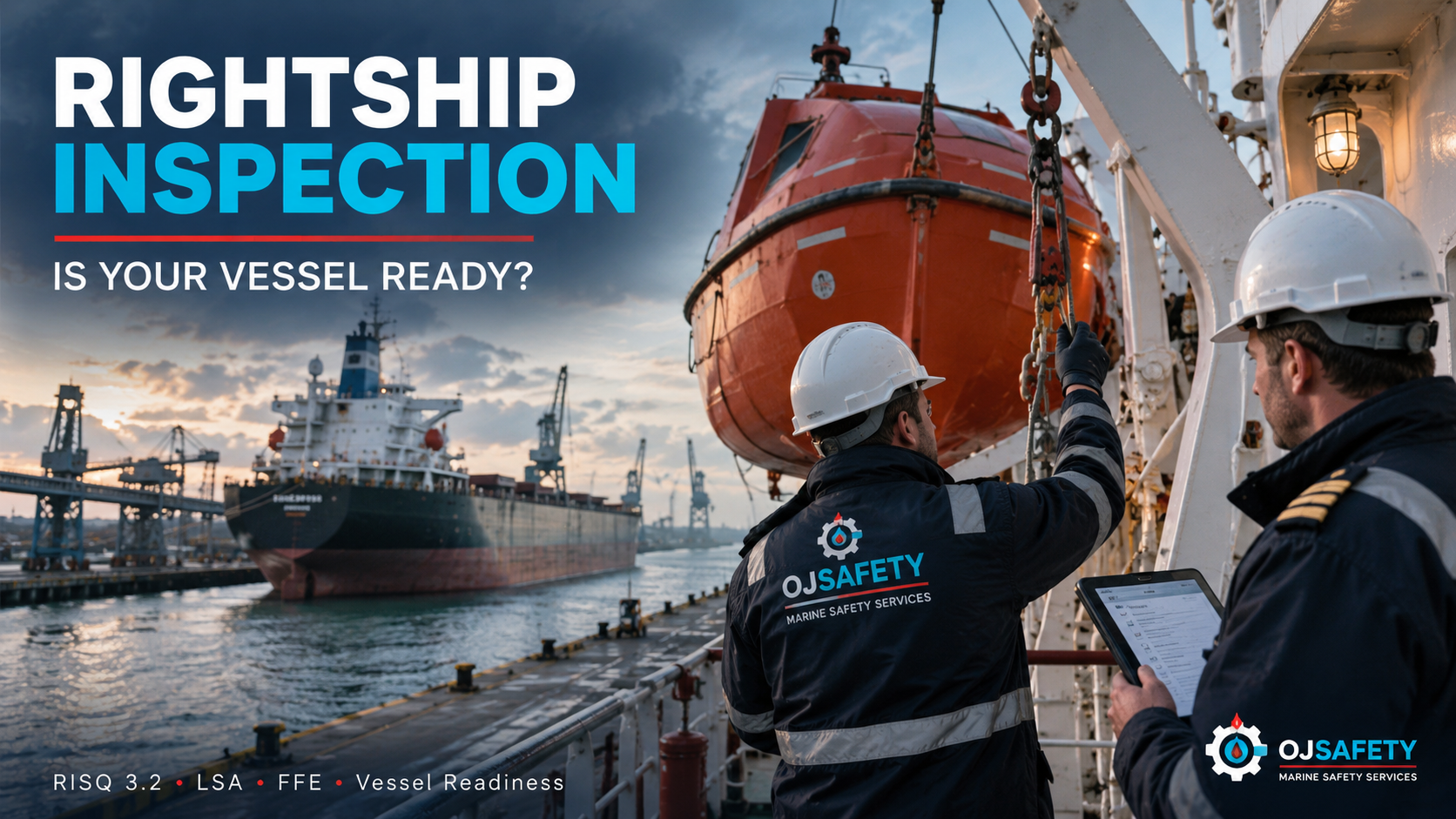
A RightShip inspection is not simply a document review.
It is an assessment of the vessel’s actual condition, Safety Management System implementation, crew familiarity, operational readiness and compliance with industry expectations.
For bulk carriers, general cargo ships, container ships and Ro-Ro vessels, the RightShip Inspection Ship Questionnaire (RISQ 3.2) provides the current inspection framework. It covers statutory requirements together with recommended and desirable practices based on IMO, ISO, ILO and wider maritime industry guidance.
For shipowners and vessel managers, the practical objective is simple: identify deficiencies before the RightShip inspector does.
What is a RightShip inspection?
A RightShip vessel inspection provides an independent assessment of:
- vessel condition;
- effectiveness of the Safety Management System (SMS);
- crew familiarity with procedures and safety equipment;
- statutory compliance;
- implementation of industry recommendations and good practice;
- operational and safety standards onboard.
The inspection outcome reflects the condition and operational standard of the vessel at the time of inspection.
That distinction matters.
A valid certificate does not automatically prove that equipment is operational, properly maintained or understood by the crew.
What is RISQ 3.2?
RISQ 3.2 is the current RightShip Inspection Ship Questionnaire used as the reference framework for applicable RightShip vessel inspections.
It applies to bulk carriers, general cargo ships, container ships and roll-on/roll-off vessels and provides both inspection questions and guidance to help managers prepare vessels and inspectors apply a consistent methodology.
RISQ examines considerably more than certificates.
The inspector may evaluate the physical condition of equipment, maintenance standards, records, procedures, SMS implementation and crew knowledge.
That is why effective preparation should combine: documents + equipment + crew + actual shipboard condition.
Which vessels currently require an acceptable RightShip inspection?
RightShip has progressively expanded its Inspection Age Trigger.
As of 1 July 2026, an acceptable RightShip inspection is required under the applicable RightShip criteria for vessels 11 years and older.
The announced next stage is:
- 1 January 2027: vessels 10 years and older.
The exact applicability should always be checked against current RightShip vetting and inspection requirements for the vessel concerned.
For managers of affected fleets, this makes inspection readiness a recurring operational requirement rather than an occasional exercise.
How should a vessel prepare for a RightShip inspection?
The most efficient approach is a pre-inspection gap assessment against the current RISQ questionnaire.
Preparation should focus on five areas:
1. Documentation
Check that statutory certificates, inspection records, maintenance records, test reports and service documentation are current and consistent.
The paperwork should correspond with the equipment actually installed onboard.
2. Physical vessel condition
Walk the vessel as an inspector would.
Look for obvious deterioration, temporary repairs, corrosion, leakage, damaged access arrangements, poor housekeeping and equipment that cannot be demonstrated correctly.
3. Safety equipment
LSA and FFE should be inspected for condition, readiness, correct maintenance and supporting records.
4. Crew familiarity
Crew members should know how safety-critical equipment is operated and what their assigned emergency duties require.
5. SMS implementation
Procedures should not merely exist in the SMS.
The vessel should be able to demonstrate that those procedures are actually followed onboard.
LSA checks before a RightShip inspection
Life-saving appliances deserve particular attention because deficiencies can often be identified quickly during a physical inspection.
Before RightShip attendance, verify as applicable:
- lifeboat and rescue boat general condition;
- launching appliances and davits;
- winches and brakes;
- falls and associated components;
- release and retrieval arrangements;
- on-load/off-load release mechanisms;
- securing arrangements;
- operational markings and instructions;
- maintenance records;
- annual and five-year inspection status;
- service reports and certificates;
- crew familiarity with launching and recovery procedures.
For equipment falling under IMO MSC.402(96), confirm that required maintenance, examination, operational testing, overhaul and repair have been completed by appropriately authorised personnel/service providers as applicable.
Flag State, Classification Society and manufacturer requirements should be verified for the specific vessel and equipment.
FFE checks before a RightShip inspection
Fire-fighting equipment should be serviceable, accessible, correctly documented and ready for immediate use.
Priority items include:
- portable and wheeled fire extinguishers;
- fire hoses, hydrants and nozzles;
- fire main condition;
- emergency fire pump;
- SCBA;
- EEBD;
- firefighter outfits;
- fixed CO₂ systems;
- foam systems;
- water mist or other fixed systems where fitted;
- fire detection and alarm arrangements;
- service dates and maintenance records.
A certificate saying that equipment was serviced does not compensate for visibly defective or inaccessible equipment onboard.
Emergency fire pump: test it before the inspector arrives
Do not wait for an inspection to discover that the emergency fire pump does not perform correctly.
Before attendance, verify:
- starting arrangement;
- suction;
- discharge pressure;
- hydrant pressure;
- valves and piping;
- leakage;
- remote arrangements where applicable;
- crew familiarity.
The objective is straightforward: when requested, the vessel should be able to demonstrate the system without improvisation.
SCBA and EEBD: check the equipment and the evidence
SCBA and EEBD problems are frequently preventable.
Check:
- cylinder pressure;
- cylinder test status;
- masks and seals;
- hoses and connections;
- demand valves;
- storage condition;
- identification;
- EEBD expiry/service status;
- location against vessel plans;
- maintenance and inspection records.
Where a breathing-air compressor is fitted, verify its maintenance and applicable air-quality testing records.
Traceability matters.
An inspector should be able to connect the physical unit → identification → service record → test status without detective work.
Crew readiness matters as much as equipment condition
RISQ specifically considers crew familiarity with the SMS and safety arrangements.
Before inspection, responsible officers and crew should therefore be familiar with:
- emergency duties;
- LSA operation;
- firefighting arrangements;
- emergency fire pump operation;
- SCBA use;
- launching arrangements;
- relevant SMS procedures;
- maintenance and testing records.
The wrong moment to discover that only one engineer knows how a system works is while the inspector is standing beside it.
How long does a RightShip inspection take?
RightShip currently describes three inspection approaches:
Standard Inspection: approximately 10–12 hours onboard.
Hybrid Inspection: approximately 8–10 hours onboard, with documentation uploaded and reviewed in advance.
Dual Inspection: two inspectors divide the relevant inspection scope.
For vessels with short port calls, early preparation and document availability can therefore have a direct operational benefit.
How early should a RightShip inspection be booked?
RightShip recommends submitting a completed inspection request approximately 14 days before the requested inspection date.
The stated minimum is 7 days.
Managers should therefore coordinate:
inspection date + port call + berth window + vessel readiness + outstanding technical work
before the vessel arrives.
Leaving technical deficiencies until the inspector has already been appointed is an unnecessarily expensive form of optimism.
What happens if RightShip finds deficiencies?
A finding does not end when the inspector leaves the gangway.
RightShip evaluates inspection validity using factors including:
- severity of findings;
- number of findings;
- quality of the close-out submission.
RISQ 3.2 also states that the inspection process cannot be completed until a satisfactory response has been received and that failure to provide one within the specified 15-day period can invalidate the inspection.
Therefore, good preparation reduces two risks: the finding itself and the management burden of closing it afterwards.
Practical RightShip pre-inspection checklist
Before attendance, the vessel manager should confirm:
- current RISQ 3.2 reviewed;
- certificates and records checked;
- outstanding PMS items reviewed;
- previous deficiencies closed;
- LSA physically inspected;
- davits, winches and release systems checked;
- FFE condition and service status verified;
- emergency fire pump tested;
- SCBA/EEBD checked;
- fixed firefighting systems reviewed;
- crew prepared for equipment demonstrations;
- SMS procedures understood onboard;
- obvious physical deficiencies corrected;
- service reports and certificates readily available.
Do not prepare only the paperwork. Prepare the ship.
Can LSA and FFE servicing be arranged before a RightShip inspection?
Yes.
Where deficiencies or overdue maintenance are identified during preparation, LSA and FFE inspection, servicing, testing and corrective work can be arranged before the RightShip inspection, subject to vessel schedule, port access and applicable Flag/Class/manufacturer requirements.
OJ Safety supports vessels with:
- lifeboat and rescue boat inspections;
- davit and winch inspection;
- release gear inspection;
- annual and five-year LSA work;
- proof-load testing;
- portable FFE servicing;
- SCBA and EEBD;
- fixed firefighting systems;
- CO₂ systems;
- emergency fire pump and fire-main testing;
- inspection documentation and compliance support.
For short port calls, the useful strategy is to identify the scope before arrival and mobilise around the vessel schedule.
RightShip inspection preparation in Europe
OJ Safety provides marine safety inspection and servicing support from Klaipėda with regular mobilisation across the Baltic, Scandinavia, North Sea and other major European maritime locations.
Core coverage includes:
Klaipėda, Riga, Liepāja, Ventspils, Tallinn, Gdańsk, Gdynia, Szczecin, Helsinki, Kotka and Turku, with wider mobilisation available for ports in Denmark, Sweden, Norway, Germany, the Netherlands, Belgium and the United Kingdom.
For a vessel preparing for a RightShip inspection, send:
vessel name + IMO number + port + ETA/ETD + equipment list + outstanding deficiencies + required scope.
The objective is not to “pass RightShip” through paperwork.
It is to have the vessel actually ready before inspection begins.
Quick answers for shipowners and managers
What is RISQ 3.2?
RISQ 3.2 is RightShip’s current inspection questionnaire and guidance framework for applicable dry cargo vessel inspections.
How do I prepare for a RightShip inspection?
Review the current RISQ, verify documentation, physically inspect the vessel, test safety-critical equipment, correct deficiencies and ensure crew familiarity.
Does RightShip inspect LSA and FFE?
Safety equipment and associated condition, maintenance, records and operational readiness form part of the wider RISQ inspection scope.
Should we conduct a pre-RightShip inspection?
A structured internal gap assessment before attendance can identify deficiencies while there is still time to correct them.
Can deficiencies be repaired during a port call?
Many LSA/FFE deficiencies can be addressed during a planned port call where technicians, spares, access and required approvals are arranged in advance.
Is RightShip the same as Port State Control?
No. RightShip inspection/vetting and statutory Port State Control are separate processes, although strong vessel condition, SMS implementation and inspection readiness are relevant to both.